Key takeaways:
- Core Definition: Prescriptive analytics is the most advanced form of data analysis, moving beyond predicting what will happen to recommend the optimal actions on what you should do.
- Practical Impact: It solves complex business challenges by prescribing specific, actionable steps — from fraud response in finance to optimized treatment paths in healthcare.
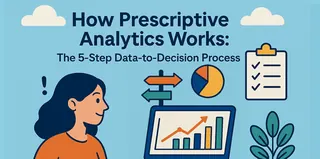
- Implementation Roadmap: Success follows a clear 5-phase process: frame the question, prepare data, generate the prescription, visualize recommendations, and execute while continuously measuring and refining.
- Accessibility: While powerful, it's increasingly accessible. The key is starting with a focused business problem, not requiring massive resources from day one.
In the modern business landscape, teams are inundated with dashboards, metrics, and reports. We have more data than ever, yet often feel paralyzed when it comes to making a decision. Why? Because knowing what happened or even what could happen doesn't answer the most critical question: "What should we do about it?"
Moving from insight to action is the ultimate challenge. This is precisely where prescriptive analytics proves its worth. It transcends traditional forecasting to deliver specific, actionable recommendations tailored to your unique business context and objectives. This article will demystify prescriptive analytics, illustrate its real-world impact, and provide a practical roadmap for leveraging its power to bridge the gap between data and decisive execution.
What is Prescriptive Analytics? The "What To Do" Layer of Intelligence
Prescriptive analytics represents the pinnacle of the data analysis maturity curve. It utilizes advanced computational techniques — including machine learning, optimization algorithms, and simulation — to not only predict potential future outcomes but to recommend the optimal course of action to achieve business goals or avoid risks.
To appreciate its role, it's essential to understand the broader analytics hierarchy:
| Type | Function | Definition | Core Question (Example) |
|---|---|---|---|
| Descriptive Analytics | The “What” | Examines historical data to summarize past performance. | “How many customers do I have?” |
| Diagnostic Analytics | The “Why” | Digs deeper to identify the root causes of past outcomes. | “Why did these customers churn?” |
| Predictive Analytics | The “What If” | Uses statistical models to forecast future probabilities and trends. | “Which customers will churn?” |
| Prescriptive Analytics | The “What To Do” | Synthesizes insights from all the above to prescribe data-driven actions. It answers the call to action that other analyses leave unanswered. | “What should we do about it?” |
Prescriptive Analytics in Practice: Solving Complex Business Challenges
Across industries, organizations are deploying prescriptive analytics to move beyond diagnosis and prediction, directly addressing their toughest operational and strategic questions.
- Finance: Prescribing Proactive Risk Mitigation. Banks use it not just to detect fraudulent patterns, but to prescribe immediate, graded responses — from transaction blocking to customer verification — balancing security loss prevention seamlessly.
- Healthcare: Prescribing Optimized Care Pathways. Hospitals employ algorithms that analyze real-time patient and resource data to recommend specific bed allocations, staff schedules, and treatment plans, directly enhancing care quality and operational throughput.
- Manufacturing: Prescribing Precise Maintenance Actions. Moving beyond simple failure alerts, systems process IoT sensor data to prescribe exact maintenance tasks and optimal scheduling, preventing downtime and extending asset life.
- Marketing: Prescribing the Next Best Engagement. By analyzing customer behavior, tools recommend the most effective channel, content, and offer for each segment, ensuring marketing spend drives maximum conversion and loyalty.
Your Roadmap to Prescriptive Action: From Planning to Execution
Integrating prescriptive analytics is a deliberate process that turns data into a clear directive. Follow this phased approach to build your capability.
1. Frame the Actionable Question
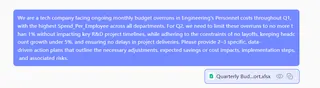
Start with a precise, high-value business dilemma. A well-scoped question like,
We are a tech company facing ongoing monthly budget overruns in Engineering's Personnel costs throughout Q1, with the highest Spend_Per_Employee across all departments. For Q2, we need to limit these overruns to no more than 1% without impacting key R&D project timelines, while adhering to the constraints of no layoffs, keeping headcount growth under 5%, and ensuring no delays in project deliveries. Please provide 2–3 specific, data-driven action plans that outline the necessary adjustments, expected savings or cost impacts, implementation steps, and associated risks.
Sets a clear target for the prescriptive model, so that AI can accurately answer your questions.
2. Integrate and Prepare Decision-Ready Data
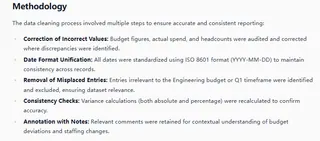
Assemble and clean data from all relevant sources. The accuracy of the prescriptive output is directly tied to the quality, consistency, and comprehensiveness of the input data. Excelmatic provides intelligent data cleaning tools that can automatically detect and handle missing values, outliers, and inconsistencies to ensure your data is in optimal condition for analysis.
3. Generate and Validate the Prescription
Leverage analytics tools or platforms to process the data, run optimization scenarios, and produce the recommended action. This step focuses on deriving the data-backed prescription itself.
4. Visualize and Socialize the Recommendation
Communicate the proposed action and its rationale through clear dashboards. Effective visualization builds trust and ensures stakeholders understand the prescriptive insight.
5. Execute, Measure, and Evolve
Implement the recommendation and track outcomes with KPIs. Use the results as feedback to refine the process, making your prescriptive analytics cycle increasingly intelligent and responsive.
From Insight to Execution: Your Prescriptive Analytics Guide with Excelmatic
In an era defined by data volume and velocity, the competitive edge goes to those who can translate information into effective action with speed and confidence. Prescriptive analytics provides the framework to make this possible, turning analytical potential into tangible business results.
Navigating this journey requires more than just intention; it requires the right toolkit. Platforms like Excelmatic are designed to streamline this entire workflow — from data integration and cleansing to generating clear, actionable recommendations. With the right partner, you can stop guessing about the next step and start executing it with precision.
Ready to transform your data from a passive asset into an active guide? Discover how a structured approach to prescriptive analytics can empower your team to make smarter, faster, and more impactful decisions every day.
Frequently Asked Questions (FAQ)
Q: Is prescriptive analytics only for big companies?
A: No. Modern platforms with user-friendly tools make it accessible. Start with a clear, focused business problem and clean data.
Q: How does this differ from a good analyst's work?
A: A great analyst provides data-driven suggestions. Prescriptive analytics augments this by using algorithms to instantly process complex data, evaluate all options, and find optimal solutions that might be missed manually.
Q: What's the key difference from predictive analytics?
A: Predictive forecasts what will likely happen (e.g., "Which customers will churn?"). Prescriptive recommends what to do about it (e.g., "Offer these specific customers a loyalty discount"). Predictive gives insight; prescriptive gives the action plan.