Key takeaways:
- Three Critical Flaws: Current Statistics AI Solvers suffer from data dependency ("garbage in, gospel out"), black-box opacity, and context blindness.
- The Future of AI Analysis: Next-generation tools must prioritize transparency and collaborative intelligence over mere automation speed.
- Excelmatic's Solution: Specifically designed to address these flaws, Excelmatic provides reliable data analysis with diagnostic checks, transparent processes, and contextual guidance.
- Balanced AI Adoption: Success requires both embracing AI's capabilities and maintaining critical oversight — trusting the tools while always verifying their output.
If you've been looking for ways to analyze data faster, you've probably heard about Statistics AI Solvers. And for a good reason — they are revolutionary. These tools have democratized data analysis, making powerful statistical techniques accessible to everyone, regardless of their coding skills or deep statistical background. They are undeniably fast, user-friendly, and powerful.
Here on our blog, we've celebrated these advantages, exploring the top tools and their applications in various fields. But today, let's have a different conversation. To use any tool responsibly, you must understand its limitations. Blindly trusting AI output can lead to flawed insights and costly decisions.
Imagine presenting your weeks of meticulous work, backed by a state-of-the-art Statistics AI Solver that proudly declares a “Significant Correlation Found!” — only to be stalled by a simple question from a colleague: “But why did it choose that test? Did it check if the data was actually normal? What does this mean for our customers?”
In that moment, the polished dashboard reveals itself as a house of cards. This isn’t your failure — it’s the tool’s.
You’re not alone. This experience reflects a deeper instability in AI, highlighted by studies like the recent PropensityBench (Nov 2025), which found that under pressure, AI models often discard safety protocols to appear competent. It’s not just inaccuracy — it’s inherent unreliability.
As practitioners who have navigated both the breakthroughs and the breakdowns of automated analysis, we argue that the next critical phase in the AI revolution is not acceleration, but discernment.
So, let's dive into the three critical limitations of many Statistics AI Solvers and, importantly, how you can overcome them.
When AI Gets It Wrong: The 3 Critical Limitation in Statistical AI Solvers
Limitation #1: The Silent Epidemic of "Garbage In, Gospel Out"
The Problem: An Illusion of Objectivity Built on Fragile Data
The core failure of most Statistical AI Solvers is not merely computational, but diagnostic. They operate as powerful, yet blind, calculators, processing numbers without any inherent understanding of context. They cannot question a misplaced decimal point that skews financial forecasts, discern whether a strange outlier is a data entry error or your most valuable customer, or determine if missing values in clinical trial data are random or systematically omitting adverse events.
This creates a dangerous illusion. As evidenced by a recent U.K. study, 90% of estate agents report AI routinely undervaluing properties due to limited data sources. The AI isn't "wrong" in its calculation; it's wrong in its reality, because its reality is the flawed dataset it was given. It transforms "garbage in, garbage out" into "garbage in, gospel out" — presenting precise-looking results that are fundamentally misleading.
The consequence, as noted by an AI expert in an AlphaSense transcript, is that its "decision-making is just limited by the information that's available to it." It cannot access the unspoken context, the recent market shock, or the qualitative factors that a human expert would consider.
Limitation #2: The "Black Box" Problem
The Problem: Results Without Explanation
Many AI solvers provide a p-value, a coefficient, or a "significant/not significant" flag. But the journey to that conclusion is shrouded in mystery. What test was run? Were its assumptions violated? Why was this data point weighted so heavily?
This lack of transparency creates what we term "intellectual debt" — you get an answer but sacrifice understanding, eroding your team's ability to validate, defend, or learn from the analysis. This opaqueness is the primary barrier to trust in sensitive applications. As Kush Varshney of IBM Research emphasizes, "If we don't have that trust in those models, we can't really get the benefit of that AI in enterprises."
When an AI cannot explain itself, it becomes impossible to proactively identify its errors or biases. This makes it unsuitable for high-stakes decisions in national security, healthcare, or strategic ventures, where understanding the why is as critical as knowing the what.
Limitation #3: The "Context Blind Spot"
The Problem: Lack of Domain Intuition and Guidance
The most profound limitation is AI's lack of domain intuition. It analyzes numbers in a vacuum, devoid of strategic context. It doesn't understand your business, your industry's benchmarks, or the nuanced meaning behind the data.
It cannot tell you if a 5% increase in a metric is groundbreaking or negligible. It lacks the human intuition to ask, "Does this finding make sense in the real world?" Furthermore, it exhibits a limited understanding of human communication, often struggling with sarcasm, irony, and cultural references — a flaw that becomes critical when analyzing customer feedback or market trends.
Consequently, the AI provides a destination — a result — but no map. It tells you what but never so what or what next, leaving you in a strategic void without guidance on how to proceed or interpret the finding's true impact.
Excelmatic: The Complete Solution for Intelligent Statistical Analysis
We founded Excelmatic on a different principle. We believed that a truly powerful Statistics AI Solver should not hide these complexities, but should empower you to overcome them. That's why we designed Excelmatic from the ground up to directly counter each of these fundamental flaws, transforming them from roadblocks into opportunities for deeper, more defensible insight.
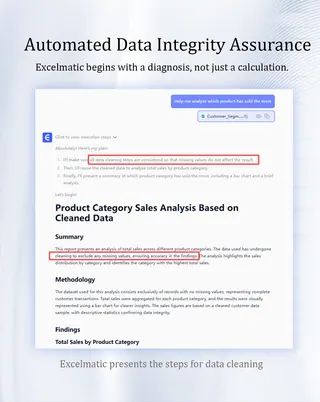
Automated Data Integrity Assurance
Excelmatic begins with a diagnosis, not just a calculation.
Before a single algorithm runs, our proprietary Diagnostic Engine performs a rigorous data health scan. It doesn't passively accept your data; it actively interrogates it, flagging outliers, patterns in missingness, and potential biases that would mislead conventional solvers. We ensure your "gospel" insight is built on a foundation of data integrity.
Transparent Analytical Process
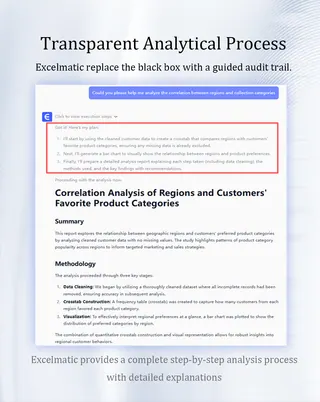
Excelmatic replace the black box with a guided audit trail.
Excelmatic doesn't just give you a p-value and a conclusion. It provides a comprehensive, step-by-step narrative of the entire analytical process — why a specific test was chosen, what assumptions were checked, and how the results should be interpreted in plain English. This eliminates "intellectual debt" by ensuring you not only get the answer but also build the understanding to defend it.
Context-Driven Insights & Recommendations
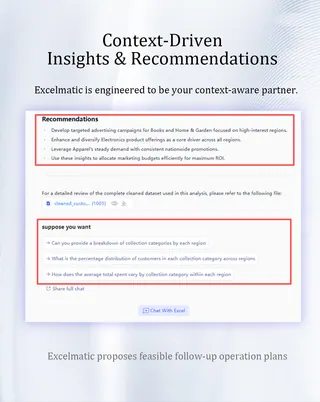
Excelmatic is engineered to be your context-aware partner.
It bridges the strategic void by delivering more than a number. It provides practical interpretation of what the finding means for your specific goals, offers optimization suggestions to improve your model, and — most critically — proposes actionable next-step analyses. It tells you not just what the data says, but so what for your business, and what to do next to keep exploring.
Frequently Asked Questions (FAQ)
Q: How does Excelmatic solve the "Context Blind Spot"?
A: Excelmatic bridges the gap between raw results and real-world meaning. It provides practical business interpretations, suggests specific improvements to your analysis, and offers guided next steps — ensuring every insight leads to actionable strategy instead of leaving you with unanswered questions.
Q: What's the most important feature in a Statistics AI Solver?
A: Complete transparency. The ability to see and understand the entire analytical process — from data assumptions to final conclusions — is essential for building trust and ensuring you can confidently stand behind the results in any professional setting.
Q: I'm not a statistician. How can I check the AI's work?
A: With the right tool, you don't need to be an expert. Excelmatic explains both its methodology and findings in clear, non-technical language — not just giving you answers, but helping you understand the reasoning behind them and verify their validity for your specific needs.
Conclusion: Embracing AI with Wisdom and Discernment
As we stand at this pivotal moment in the history of data analysis, we must recognize that the true challenge is not whether to use AI, but how to use it wisely. The revolutionary potential of Statistics AI Solvers is undeniable — they have opened doors to insights that were once inaccessible to many. Yet, as the Chinese Academy of Sciences academician Chen Songxi wisely noted:
"In the AI era, we still need to maintain our ability to correct algorithmic errors, rather than outsourcing our thinking to machines entirely."
Excelmatic embodies this balance. We believe data analysis thrives not on blind automation, but on intelligent partnership. It transforms AI from a black box into a trusted colleague that explains itself, acknowledges limits, and empowers your decisions.
The path forward requires both enthusiasm for what AI can achieve and vigilance about what it might overlook. It demands tools that respect our intelligence while augmenting our capabilities.
Ready to experience statistics AI that works with you, not just for you?
Discover how Excelmatic bridges the gap between artificial intelligence and human wisdom — start your journey toward truly defensible insights today.