Key takeaways:
- A strategic dashboard focuses on decision meaning, not just reporting numbers. It helps leaders interpret what performance changes imply for strategy and what actions should follow.
- Strategic dashboards typically fall into a few core types, such as product portfolio, market expansion, M&A integration, and digital transformation dashboards. Each type is designed to answer a specific strategic question rather than track day-to-day operations.
- Effective strategic dashboards are built by linking metrics directly to strategic objectives and key drivers. Instead of generic KPIs, they organize indicators around cause-and-effect relationships that explain why results change.
- Scenario simulation turns strategic dashboards into forward-looking decision tools. By testing different strategic options, executives can align teams around a shared narrative and reduce uncertainty before committing resources.
It's time for the monthly business review. The conference room screen shows slide 47: "Regional Sales Overview." The data show Western market revenue up 12%, but gross margin down 4 percentage points. The head of sales emphasizes the growth; the CFO presses on profit. You need to decide: is this a temporary blip or a structural problem?
The issue isn't a lack of data. Your company generates massive volumes of data every day — transaction records, customer interactions, operations logs. The problem is that when you need to make critical decisions, the "reports" you have can't answer the most fundamental questions: what's the real story behind these numbers? What does this mean for our strategy going forward?
That's exactly the problem a strategic dashboard is meant to solve.
What is a strategic dashboard?
A strategic dashboard is not an upgraded operations-monitoring tool; it's a fundamentally different decision-support system.
The simplest way to tell the difference is to look at the question each answers:
- An operational dashboard answers: "What happened? What is the current situation?"
- A strategic dashboard answers: "What does this mean? How should we respond?"
Functionally, a strategic dashboard is an analytical system that integrates multiple data sources, focuses on key strategic objectives, reveals causal relationships, and supports forward-looking decisions. It turns scattered metrics from sales, finance, operations, and marketing into a coherent narrative about how the company's strategy is being executed.
The real strategic value shows up when revenue rises but profits fall. A strategic dashboard won't just display those two numbers; it will reveal that the decline is due to a pricing change in a particular product line implemented three months ago, which has already altered customer buying behavior and could continue to compress overall margins for the next two quarters.
In short, a strategic dashboard helps leaders understand what the data means for future decisions.
Who needs a strategic dashboard?
Strategic dashboards serve the people within an organization who are responsible for strategic decisions.
1. Senior executives (CEO, CFO, COO)
For them, a strategic dashboard turns annual strategic goals into daily, monitorable indicators. When the board asks, "How is our new market expansion progressing?" there's no need to compile ten departmental reports. One interface shows the health of key strategic metrics: market penetration, variance between actual and planned customer acquisition cost, product localization acceptance, and so on.
2. Heads of strategy and business analytics
Their core work shifts from "producing reports" to "building analytical frameworks." The strategic dashboard becomes a sandbox for testing strategic hypotheses: "If we increase R&D spend by 15% and move toward a premium product line, what will that do to market share and margins over the next three years?" By tweaking a few parameters, you can see the potential outcomes of different strategic paths.
3. Cross-functional leadership teams
When sales asks for more capacity, operations stresses cost control, and finance watches cash flow, a strategic dashboard provides a common basis for decisions. It clearly shows that to hit fourth-quarter penetration targets the real bottleneck is supply-chain responsiveness — not sales capability or funding. That shifts the conversation from positional arguments to problem-solving.
The three core components of a strategic dashboard
An effective strategic dashboard has a clear hierarchy, with each layer serving different decision-making needs.
1. Layer 1: Strategic objective status
This layer typically consists of 3–5 core metrics that map directly to the company's strategic priorities. These aren't ordinary KPIs but designed "strategic metrics." For example, instead of "total sales," you track "share of high-margin product lines in emerging markets"; instead of "number of customers," you track "retention and lifetime value of high-value customer segments." These metrics are directly tied to the outcomes of strategic choices.
2. Layer 2: Driver analysis
When a core metric changes, this layer explains why. It displays a network of causal relationships between key metrics. For example, a drop in high-margin product share might be linked to delayed product launch cycles, insufficient channel capability, intensified competitor promotions, or shifts in target customer demand. This layer provides explanation, not just data.
3. Layer 3: Decision-support simulations
This is what sets a strategic dashboard apart from a reporting system. At this layer, decision-makers can simulate the outcomes of different courses of action: "If we raise prices by 5% in Western Europe while offering tailored services to major accounts, what might that do to full-year revenue and market share?" The system uses historical data and business rules to run projections, helping evaluate potential returns and risks for various strategic choices.
Without any one of these layers, the system struggles to support true strategic decision-making.
Four common strategic dashboard use cases
The specific form a strategic dashboard takes depends on the strategic questions it serves.
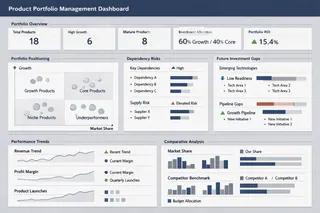
1. Product portfolio management dashboard
This isn't a product sales leaderboard; it's an analytical tool built on strategic frameworks like the Boston Matrix. It continuously evaluates each product line's market growth and relative share, identifying which are "cash cows" (to be maintained), "stars" (to invest in), or "question marks" (to be repositioned). A typical alert it raises is when a company is overly dependent on products approaching decline while underinvesting in those that are growing.
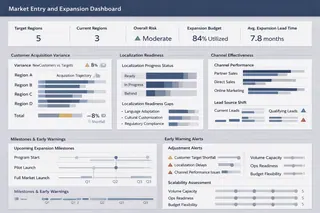
2. Market entry and expansion dashboard
Entering a new market is a major strategic commitment. This dashboard tracks not surface-level performance but the critical success factors: variance between actual customer acquisition cost and the business plan, market acceptance of localization changes, channel partner effectiveness metrics, progress on regulatory approvals, and so on. Its core role is to provide early signals to help decide whether to scale up investment or adjust strategy.
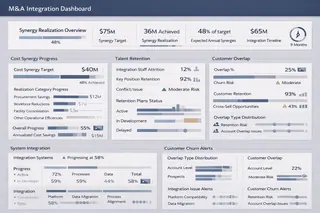
3. M&A integration dashboard
During post-merger integration, the strategic dashboard monitors progress on realizing synergies: completion of cost-saving targets, retention of key talent, customer overlap and cross-selling opportunities, system integration milestones, and more. It turns the fuzzy idea of "synergies" into trackable, manageable metrics.
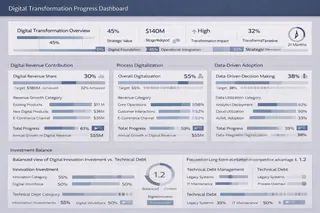
4. Digital transformation progress dashboard
For a company's digital strategy, this dashboard measures the depth and effectiveness of transformation: share of revenue from digital products, digital coverage of key business processes, adoption rate of data-driven decision-making, balance between technical debt and innovation investment, and so on. It helps answer: "Are our digital investments creating competitive advantage or just maintaining the status quo?"
Using Excelmatic to build your strategic dashboard
If the data for your strategic dashboard is scattered across different project management tools, messy spreadsheets, or disconnected from daily operational data, its value is greatly diminished. That disconnect prevents the company from making fast, wise decisions, causing strategic drift, missed targets, and slow responses to market changes.
Excelmatic confronts this challenge. It doesn't ask you to overthrow your existing data workflows. Instead, it uses the Excel you already know as the starting point to intelligently consolidate spreadsheet data scattered across departments and projects. Through its natural-language analysis engine, you can simply describe your strategic analysis intent — for example, "show the relationship between product-line margins and customer satisfaction in our newly entered Asian markets."
The system automatically parses your request, identifies key metrics and dimensions from the uploaded Excel files, and generates a dynamic, interactive strategic view. That means data is no longer static numbers but a bridge between strategic goals and actual execution. You can drill down and filter to move from high-level strategic objectives to the specific operational drivers.
The strategic dashboards generated by Excelmatic deliver core value by placing day-to-day operational data directly under strategic objectives, making it clear to teams how each effort advances the strategy. This ensures the organization can discuss, collaborate, and decide from the same real-time, accurate data picture — speeding up the achievement of strategic goals. Want to experience how to quickly turn Excel data into strategic insights?
Start a free trial of Excelmatic now.
Frequently Asked Questions (FAQ)
Q: What is a strategic dashboard?
A: A strategic dashboard is a decision-support tool that links business data to strategic goals, helping leaders understand implications and choose actions.
Q: How is a strategic dashboard different from an operational dashboard?
A: Operational dashboards show current performance, while strategic dashboards explain why results happen and what to do next.
Q: Who should use a strategic dashboard?
A: Senior executives, strategy leaders, and cross-functional leadership teams responsible for long-term decisions.
Q: What are the core components of a strategic dashboard?
A: Strategic objectives, driver analysis, and decision-support simulations.
Q: When does a company need a strategic dashboard?
A: When growth, profitability, or execution gaps cannot be explained by standard reports alone.