
Key Takeaways:
- Traditional Excel row insertion methods require manual clicking, selecting, and remembering complex shortcuts that can lead to errors
- Excelmatic eliminates manual steps by letting you insert multiple rows using simple language commands
- Compared to traditional methods, Excelmatic handles any number of row insertions instantly without risking data integrity
- For business professionals, adopting AI tools means faster spreadsheet management and more time for analysis rather than technical operations
Inserting multiple rows in Excel is a common task, but if you don't know the right tricks, it can be a frustrating and time-consuming problem. Luckily, there are several easy solutions. While traditional methods involving clicks and shortcuts work well, a new AI-powered approach can do it even faster and more intuitively.
In this article, we'll show you the quickest manual methods first, then dive into a comprehensive list of all the ways to get this done. We'll also introduce an AI agent, Excelmatic, and compare its approach to the traditional ways, so you can choose the absolute best method for your workflow.
Quick Answer: The Traditional Way
For a quick manual insertion of multiple rows in Excel, follow these steps:
- Select the number of rows you want to insert by clicking and dragging on the row numbers.
- Right-click the highlighted selection and choose Insert.
- Excel will automatically insert the same number of blank rows above your selection.
Excel then shifts the existing data down and adds new rows. This is a reliable way to get the job done on Windows or Mac. But is it the fastest? Let's explore all the options.
Full List of Ways to Insert Multiple Rows in Excel
Let's now look more comprehensively at all the different methods, starting with the manual techniques before moving on to the AI-powered solution.
Method 1: Insert Multiple Rows Using the Right-Click Menu
The quickest and most common manual method is using the Insert option from the right-click menu, which I mentioned above. Here it is again with more detail.
Simply select the number of rows you want to add. For example, if you need 3 new rows, highlight 3 existing rows where you want them to appear. Then, right-click the selected area and click Insert.

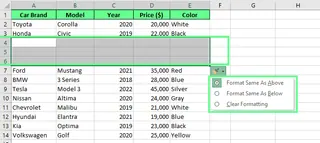
This way, Excel automatically shifts the existing rows down and adds new blank ones. After adding new rows, you’ll see a small Insert Options button next to them. It gives you three choices to adjust the formatting so the new rows blend in:
- Format Same As Above: Copies the style from the row above.
- Format Same As Below: Uses the formatting from the row beneath the inserted rows.
- Clear Formatting: Clears all styles and keeps the new rows in Excel’s default look.
Method 2: Insert Multiple Rows Using a Keyboard Shortcut
Instead of clicking through menus, you can add rows instantly using keyboard shortcuts. This is especially helpful if you're a power user working with large datasets.
First, select the number of rows you want to add. For example, if you need 2 new rows, highlight 2 existing rows. Then, press Ctrl + Shift + "+" on Windows or Cmd + Shift + "+" on Mac. In some versions of Excel, a pop-up window may appear; if so, choose the Entire row option.

Method 3: Insert Multiple Rows Using Copy and Paste
Copy-and-paste is another clever way to add multiple rows, which can be useful for preserving specific row heights or formats.
To use this method, select some existing blank rows from another part of your spreadsheet (or insert them first). Copy them with Ctrl + C (or Cmd + C on Mac). Then, go to the spot where you want the new rows, right-click, and select Insert Copied Cells.

Excel moves everything down and places the copied rows exactly where you want them, maintaining the formatting of the cells you copied.

Method 4: Insert Multiple Rows Using the Name Box
The Name Box offers a precise way to select a large number of rows without manual dragging. The Name Box is the small box to the left of the formula bar.
Click on it and type the row range you want to select. For example, if you want to insert 5 rows starting from row 4, you'd want to select 5 rows to be shifted down. So, you type 4:8 and press Enter. This instantly highlights rows 4 through 8.
Next, right-click on the selection and choose Insert. Excel adds 5 new blank rows and shifts the previously selected rows down. This is a quick and precise way to handle large insertions.

Method 5: The AI-Powered Way with Excelmatic

What if you could insert rows just by asking? That's where AI tools like Excelmatic come in. Excelmatic is an Excel AI Agent that performs tasks for you based on plain language instructions. Instead of clicking, selecting, and remembering shortcuts, you just tell it what to do.
Here’s how you would insert multiple rows using Excelmatic:
- Upload your Excel file to the Excelmatic platform.
- State your request in the chat box. For example, you could type:
- "Insert 5 new rows above row 9."
- "Add 20 blank rows starting at row 50."
- "I need to add a new row between row 3 and row 4."
- Done. Excelmatic processes your request, inserts the rows exactly as specified in your file, and makes the updated file available for download.
This method eliminates all manual steps. You don't need to select anything, right-click, or use shortcuts. It's the most straightforward and error-proof way to modify your spreadsheet.

Traditional Methods vs. The AI Approach: A Quick Comparison
How do these methods stack up? Here’s a side-by-side look.
| Feature | Manual Methods (Right-Click, Shortcut) | AI Agent (Excelmatic) |
|---|---|---|
| Process | Select rows -> Right-click -> Insert | Upload file -> Type instruction -> Download |
| Speed | Fast for a few rows, slower for many | Instant, regardless of the number of rows |
| Ease of Use | Easy, but requires manual action | Effortless, fully conversational |
| Learning Curve | Low (but requires remembering steps) | None (just type what you want) |
| Error Potential | Moderate (e.g., selecting wrong rows) | Very Low (AI interprets the command) |
| Best For | Quick, simple edits | Any task, especially large or repetitive insertions |
Common Issues and How to Fix Them
Sometimes, inserting rows doesn’t go as planned. Here are common problems and how to fix them.
- Inserted rows overwrite existing data: This can happen if you use a standard Paste (
Ctrl+V) instead of Insert Copied Cells. To avoid this, always right-click and choose the correct "Insert" option, which shifts cells down. If you make a mistake, just pressCtrl + Zto undo it. - Excel shows an error when inserting rows: This usually happens if you're trying to insert rows into a protected sheet or if the operation would break a table or other structured data. Ensure there's enough space and the area is editable.
Using an AI tool like Excelmatic can help prevent these issues, as it is designed to handle the underlying mechanics of Excel operations correctly, ensuring data integrity.
Final Thoughts
Excel provides many ways to insert multiple rows. The manual methods—right-click, keyboard shortcuts, copy-paste, and the Name Box—are fundamental skills that are great for quick edits. They give you direct control over your worksheet.
However, for ultimate speed, simplicity, and accuracy, an AI-powered approach with Excelmatic is a game-changer. By simply stating your needs in plain language, you can bypass all the manual steps, reduce the chance of error, and get your work done faster.
Ready to transform your Excel workflow? Try Excelmatic today and experience the power of AI-driven spreadsheet management. Simply describe what you need in simple language and let Excelmatic handle all the technical operations - no clicks, no shortcuts, no errors, just instant results that save you time and frustration.
Try out the different methods to see which fits your workflow best. As you tackle more complex tasks, you may find that letting an AI agent handle the tedious work is the most efficient path forward.
FAQ
Can I insert multiple rows in a table?
Yes, you can insert multiple rows in an Excel table. Here’s how to do it:
- Select the same number of rows in the table as you wish to add.
- Right-click within the selection and choose Insert.
- Then select Table Rows Above.
Alternatively, with Excelmatic, you could just say, "In the 'SalesData' table, insert 3 rows above row 5."
How do I insert rows below a selected row in Excel?
To insert rows below a specific row in Excel:
- Select the row below where you want to insert your new rows. For example, to insert rows below row 5, select row 6.
- Right-click and select Insert. The new rows will appear above your selection (and thus, below row 5).
How do I add rows in Excel using the Ribbon?
Here’s how you can insert rows using the Ribbon:
- Select your desired row and drag to select multiple rows.
- Go to the Home tab > Cells group > click the Insert dropdown.
- Choose Insert Sheet Rows from the menu.
- New rows will be added above your selection automatically.