Key takeaways:
- Long, nested Excel formulas with repeated calculations are difficult to write, debug, and maintain, creating a significant bottleneck in data analysis.
- While the
LETfunction helps by naming and reusing parts of a formula, it still requires advanced Excel knowledge. An Excel AI like Excelmatic completely removes the need to write formulas by understanding plain language commands. - With Excelmatic, you can describe complex business logic conversationally, saving hours of work, eliminating formula errors, and making your analysis accessible to anyone on your team, regardless of their Excel skill level.
The Challenge: Why Complex Excel Formulas Are a Headache
Imagine you're a sales manager preparing a monthly commission report. Your raw data is simple enough: a table with car models and their sales figures for the last two months. But the commission logic isn't a straightforward sum. Your company has a tiered bonus system: if a model's total sales exceed a certain threshold, it gets a higher bonus multiplier.
How do you translate this business rule into an Excel formula?
You'll likely start with a combination of SUM and IF functions. For a single row, the formula might look something like this:
=IF(SUM(C2:D2)>5, SUM(C2:D2)*10, SUM(C2:D2)*5)

Instantly, you can see the problem. The SUM(C2:D2) part is repeated three times. This isn't just inefficient; it's a breeding ground for errors.
This is a classic Excel pain point that scales badly:
- Hard to Read: The longer the formula, the harder it is to understand the logic at a glance.
- Error-Prone: If you need to change the range or the logic, you have to update it in multiple places. A single typo in one of the repetitions can break the entire calculation.
- Difficult to Maintain: Handing this spreadsheet over to a colleague? Get ready for a long explanation. If they aren't an Excel expert, they'll struggle to update or debug your work.
- Poor Performance: On large datasets with thousands of rows, Excel has to calculate the same
SUMmultiple times for each row, which can slow down your workbook.
For years, this was just "the way things were done" in Excel. Then, Microsoft introduced a function designed to tackle this exact problem.
The Traditional Fix: Simplifying with the Excel LET Function
To address the issue of repeated calculations and improve formula readability, Microsoft introduced the LET function in Excel 2021 and Microsoft 365. The LET function allows you to assign names to calculation results and then reuse those names within a final calculation.
Think of it as creating temporary variables directly inside your formula.
How the LET Function Works
The basic syntax is:
LET(name1, value1, [name2], [value2], ..., calculation)
name1: The first name you want to assign (e.g.,total_sales).value1: The value or calculation you want to assign toname1(e.g.,SUM(C2:D2)).calculation: The final formula that uses the names you've defined.
Let's rewrite our sales bonus formula using LET:
=LET(SALES, SUM(C2:D2), IF(SALES>5, SALES*10, SALES*5))
Here's the breakdown:
SALES, SUM(C2:D2): We define a name,SALES, and assign it the result ofSUM(C2:D2). Excel calculates this sum only once.IF(SALES>5, SALES*10, SALES*5): This is our final calculation. We can now use the clean, readable nameSALESinstead of repeating theSUMfunction.
The result is a formula that is more efficient, easier to read, and simpler to debug. It's a definite improvement. But does it solve the core problem?
The Lingering Problems of the LET Function
While LET is a powerful tool for advanced users, it's a patch, not a revolution. Several fundamental challenges remain:
- You Still Need to Be a Formula Expert: To use
LET, you already need to be comfortable with writing complex, nested formulas. It's a tool for power users, not for the average business professional who just wants to get an answer. - The Learning Curve is Steep:
LETis not an intuitive, beginner-friendly function. Many users who could benefit from it don't even know it exists or how to use it correctly. - It's Still Rigid and Manual: What happens when your manager says, "Great, now can we change the threshold to 7 and the multiplier to 12? And add a cap of $200?" You're right back to manually editing a formula, risking syntax errors with every change.
- It's Not Truly "Readable": While it's more readable to an Excel guru, your marketing director won't understand
=LET(SALES,...). The underlying logic is still trapped in code.
The LET function cleans up the syntax, but it doesn't change the fundamental workflow: you still have to manually translate business logic into rigid, unforgiving code. In the era of AI, there's a much better way.
The Modern Solution: Using an Excel AI Agent (Excelmatic)
Instead of trying to become a better formula writer, what if you could skip writing formulas altogether? That's the promise of Excel AI agents like Excelmatic.

Excelmatic is a tool that integrates directly with your spreadsheets. You upload your Excel or CSV file, and instead of clicking through menus or typing formulas, you simply have a conversation with an AI assistant. You describe the outcome you want in plain language, and the AI does the heavy lifting.
A New Paradigm: From Writing Formulas to Asking Questions
Let's revisit our sales bonus problem. With Excelmatic, you don't need to think about IF, SUM, or LET. You just need to describe the business rule. The process is transformed from a technical task into a simple conversation.
Step-by-Step: Solving the Sales Bonus Calculation with Excelmatic
Here’s how you would solve the exact same problem in a few minutes with Excelmatic.
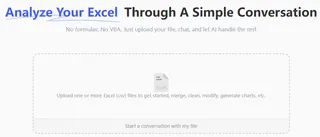
1. Upload Your Sales Data
First, you upload your Excel file containing the car sales data to the Excelmatic platform. The AI instantly reads your table and understands the columns, like 'Car Model', 'January Sales', and 'February Sales'.
2. Describe Your Business Logic in Plain Language
Now, you start a chat with the AI. Instead of writing a formula, you type a request, just like you would ask a colleague for help.
You could start simple:
Create a new column called 'Total Sales' that is the sum of 'January Sales' and 'February Sales'.

The AI will immediately add this new column to your data preview.
That's it. No functions, no cell references, no syntax to remember.
3. Review and Refine the AI's Output
Excelmatic will process your request and instantly generate the 'Bonus' column with the correct calculations. It might even show you the formula it generated behind the scenes for transparency—often an efficient one using LET! This gives you the best of both worlds: the simplicity of natural language and the power of an expertly crafted formula.
4. Iterate with Follow-up Questions
This is where AI truly outshines any manual formula. Remember the manager's request for changes? With Excelmatic, it's effortless.
Actually, change the logic. The multiplier for sales over 5 should be 12, not 10.
Or:
Can you highlight all rows where the bonus is over $100?
Or even:
Sort the entire table from the highest bonus to the lowest.
Each request is a simple follow-up, and the AI updates the results in seconds. This conversational iteration is impossible with static, manually written formulas.
5. Export Your Results
Once you're happy with the results, you can download the fully updated Excel file with all the new columns and formatting. You can also copy the formula the AI generated and paste it into your original workbook if you wish.
A Sample Conversation with Excelmatic
Here's what that entire workflow could look like in a real chat:
User: I've uploaded my car sales report. It has sales for January and February. First, can you create a 'Total Sales' column by adding the sales from those two months?
Excelmatic: Done. I've added the 'Total Sales' column, which sums the values from 'January Sales' and 'February Sales' for each row.
User: Perfect. Now I need to calculate a bonus. Please add a 'Bonus' column. If 'Total Sales' is more than 5, the bonus is 'Total Sales' * 10. If not, it's 'Total Sales' * 5.
Excelmatic: I have now calculated the 'Bonus' column based on your logic. For transparency, the formula used for the first data row is =LET(total, C2+D2, IF(total>5, total*10, total*5)). Would you like me to sort the results or create a chart?
User: Yes, please sort the table to show the car models with the highest bonus at the top.
Excelmatic: The table has been sorted in descending order by the 'Bonus' column. You can download the updated file now.
LET Function vs. Excelmatic: A Quick Comparison
| Feature | Using LET Function (Manual) |
Using Excelmatic (AI) |
|---|---|---|
| Required Skill | Intermediate to Advanced Excel knowledge. | Ability to describe a business rule in language skills. |
| Speed | Faster than not using it, but still requires manual formula writing and debugging. | Near-instant results after typing a short prompt. |
| Flexibility | Low. Changing logic requires careful and error-prone formula editing. | High. Changes are made via simple follow-up questions. |
| Accessibility | Low. Only for users who are comfortable with complex formulas. | High. Accessible to anyone, from interns to executives. |
| Error Rate | Medium. Syntax errors, typos, and incorrect cell references are common. | Very Low. The AI handles all syntax and logic, minimizing human error. |
Frequently Asked Questions (FAQ)
1. Do I need to know the LET function to use Excelmatic?
Not at all. Excelmatic is designed to eliminate the need for you to write formulas. You describe the logic, and the AI generates the correct formula and result for you.
2. Can Excelmatic generate complex formulas that use LET?
Yes. For efficiency, Excelmatic will often generate best-practice formulas, which may include functions like LET, XLOOKUP, or dynamic arrays. You get the benefit of an advanced formula without having to write it yourself.
3. Is my data safe when I upload it to Excelmatic? Data security is a top priority. Excelmatic uses enterprise-grade encryption and has strict data privacy policies. Your data is processed securely and is never used for training models without your consent. For specific details, always refer to the official privacy policy.
4. What if my business logic is much more complicated than this example? Excelmatic is built to handle multi-step, complex analysis. You can chain commands together conversationally, asking the AI to filter data, create pivot tables, merge datasets, and then apply calculations, just as you would do manually but in a fraction of the time.
5. Does Excelmatic just give me the final numbers, or can I see the formula? Excelmatic provides both. You see the immediate result in a data preview, and you can also ask the AI to show you the exact formula it used. This transparency allows you to learn, verify, and even reuse the formulas in other workbooks.
Stop Wrestling with Formulas: Upgrade Your Workflow with Excelmatic
Every hour you spend deciphering a nested IF statement or debugging a LET function is an hour you're not spending on strategic analysis. The LET function was a good step forward, but it's a tool from a past era of manual spreadsheet work.
The future of data analysis is conversational. It's about focusing on the "what"—your business goals—and letting an intelligent assistant handle the "how"—the complex Excel syntax.
Ready to ditch the formula editor for good? Upload a spreadsheet you're working on right now and ask your first question. You can even copy and paste one of the prompts from this article to get started.
Try Excelmatic for free today and experience the future of working with Excel.