
Key takeaways:
- Analyzing related data from multiple files (e.g., sales, customers, products) in Excel often requires complex tools like Power Pivot, which involves a steep learning curve with data modeling and DAX formulas.
- Excelmatic, an Excel AI agent, eliminates this complexity by automatically understanding relationships between your uploaded files, allowing you to ask for analysis in plain language.
- Instead of manually building data models and writing DAX measures, you can use Excelmatic to generate complex pivot tables, charts, and reports in seconds, dramatically improving efficiency and flexibility.
Problem background & pain points
Imagine you're a sales analyst, and at the end of each quarter, you receive three separate CSV files: sales_transactions.csv, customers.csv, and products.csv.
- The sales file has thousands of rows, each with a
TransactionID,Date,CustomerID,ProductID, andSaleAmount. - The customers file links
CustomerIDtoCustomerNameandCountry. - The products file links
ProductIDtoProductNameandCategory.
Your manager asks two seemingly simple questions: "What were our top 5 selling products by revenue this quarter?" and "Which countries generated over $10 million in sales?"
Immediately, you hit a wall. The sales data only has IDs. To get product names and customer countries, you need to combine information from all three files. The classic approach? A nightmare of VLOOKUP or INDEX/MATCH formulas, trying to pull everything into one massive, unmanageable master sheet. This method is not only slow and incredibly error-prone but also pushes Excel to its limits, often leading to crashes with large datasets.
The Traditional Excel Solution: The Power Pivot Method
For experienced Excel users, the "correct" way to handle this is not VLOOKUP, but Power Pivot. Power Pivot is a powerful add-in that allows you to load multiple tables into a "Data Model" and create relationships between them, effectively building a mini-database inside your Excel workbook.
This approach is undoubtedly more robust than VLOOKUPs. Here’s a high-level overview of the manual steps involved:
- Enable the Add-in: First, you have to find and enable the Power Pivot COM add-in from Excel's options menu.
- Import Data into the Model: You use Power Query (
Data > From Text/CSV) to import each of your three CSV files. Critically, you must choose to "Only Create Connection" and "Add this data to the Data Model" instead of loading them as worksheets. - Create Relationships: You then open the Power Pivot window, go to the "Diagram View," and manually create relationships by dragging and dropping the key fields. You'd connect
CustomerIDfrom theSalestable to the corresponding ID in theCustomerstable, and do the same forProductID. - Build a PivotTable: With the model built, you can finally insert a PivotTable. The PivotTable field list will now show all three tables, and you can pull fields from any of them. For example, you can drag
ProductNamefrom theProductstable to Rows andSaleAmountfrom theSalestable to Values. - Write DAX Measures (Optional but Recommended): For more sophisticated analysis, you're encouraged to write formulas using DAX (Data Analysis Expressions). For instance, instead of just dragging
SaleAmountinto the values field (an "implicit measure"), you'd create an "explicit measure" likeTotal Revenue := SUM(Sales[SaleAmount]).
Limitations of the Power Pivot Approach
While powerful, this workflow turns a business analyst into a part-time data engineer. It's fraught with its own challenges:
- Steep Learning Curve: You're no longer just using Excel. You're learning data modeling principles (fact vs. dimension tables, cardinality) and a new formula language (DAX). This is a significant time investment.
- Time-Consuming Setup: The process of importing, modeling, and creating measures is tedious. Before you can even begin to answer your manager's question, you might spend 30 minutes to an hour just setting up the model.
- Rigidity: The model is built for a specific purpose. If your manager comes back with an ad-hoc question like, "What's the average transaction size for our top 3 products in Germany?", you might need to go back, adjust the model, or write a new, complex DAX measure. It's not built for conversational, on-the-fly analysis.
- Complexity: DAX is powerful but can be cryptic and difficult to debug. A misplaced comma or incorrect function can break your entire report, and finding the error isn't always straightforward.
You're spending more time building the engine than driving the car.
The New Solution: Using Excel AI with Excelmatic
What if you could skip the entire data modeling and DAX-writing process? What if you could just give Excel your files and ask your questions directly? That’s exactly what an Excel AI Agent like Excelmatic is designed for.

Excelmatic understands your data and the relationships within it, allowing you to perform complex, multi-table analysis through simple conversation.
Step-by-Step: From Three Files to Instant Answers
Let's solve the same problem using Excelmatic.
1. Upload Your Data Files
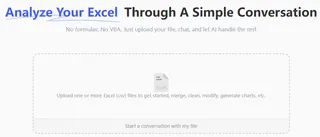
Go to Excelmatic and upload all three files—sales_transactions.csv, customers.csv, and products.csv—in one go. The AI will ingest them and prepare them for analysis.
2. Describe Your Goal in Plain Language
Instead of building a data model, you simply talk to the AI. To find the top 5 selling products, you would ask:
Using the three files, join them to find the total sales for each product name. Then show me the top 5 products with the highest total sales.
To find the top countries, you could ask:
Show me a list of countries where the total sales amount is greater than 10,000,000. Sort the list from highest to lowest sales.

3. View and Iterate on the Results
Excelmatic will process your request, automatically figure out that CustomerID in the sales file links to the customer file, and do the same for products. It will then generate a pivot table or a data summary that directly answers your question.
The best part is that this is just the start of a conversation. You can easily refine the results:
- "Great. Now, can you turn that top 5 product list into a bar chart?"
- "For the list of countries, add a column showing the total number of transactions for each."
- "Filter this entire analysis to only include sales from Q1."
This conversational approach makes ad-hoc analysis incredibly fast and intuitive.
4. Export Your Finished Report
Once you're satisfied, you can download the results—including the generated tables and charts—as a new, clean Excel file. You get the final answer without ever having to write a formula or manually create a relationship.
Example Conversation with Excelmatic
Here's how that entire interaction might look:
User: I've uploaded three files: sales, customers, and products. Please join them and create a pivot table showing the total sales for each product name, sorted from highest to lowest.
Excelmatic: I have joined the three files based on the common ID columns. Here is the pivot table showing total sales by product name. The top product is "Pro-Grade Laptop Stand" with $450,230 in sales.
User: Perfect. Now, filter that list to show only the top 5 products. Also, create a new analysis to show which countries had total sales over $10,000,000.
Excelmatic: I have updated the first table to show only the top 5 products by sales. I have also created a second summary table. The countries with over $10,000,000 in sales are the USA, UK, and Germany. Would you like to add any charts?
User: Yes, create a column chart for the top 5 products.
Excelmatic: Done. The column chart has been added. You can now download the Excel file containing both tables and the chart.
Power Pivot vs. Excelmatic: A Quick Comparison
| Feature | Traditional Power Pivot | Excelmatic (Excel AI) |
|---|---|---|
| Data Connection | Manual relationship building in a data model | Automatic relationship detection via AI |
| Calculations | Writing DAX formulas (e.g., SUMX, CALCULATE) |
Describing calculations in plain language |
| Flexibility | Rigid; changes often require model/DAX edits | Highly flexible; adjust with conversational prompts |
| Time to Insight | 30-60 minutes for initial setup | < 2 minutes to get the first answer |
| Required Skills | Data modeling, Power Query, DAX syntax | Business logic and plain language |
FAQ
1. How does Excelmatic know how to connect my files?
Excelmatic's AI analyzes the column headers and data patterns across your uploaded files. It intelligently infers that a column named CustomerID in one file likely relates to a column named CustID or Customer ID in another, and automatically proposes or creates these relationships.
2. Do I need to know any DAX or Power Pivot concepts to use Excelmatic? Not at all. The entire purpose of Excelmatic is to abstract away that technical complexity. You only need to know what business question you want to answer.
3. Is my data secure when I upload it to Excelmatic? Yes, data security is a top priority. Excelmatic uses secure protocols for data transfer and storage. For specific details on data handling and privacy, please refer to the official privacy policy on the website. Your original files are never modified.
4. Can Excelmatic handle large datasets that normally require Power Pivot? Yes, Excelmatic is built on a cloud infrastructure designed to process datasets far larger than what a standard Excel worksheet can comfortably handle, making it a viable alternative to Power Pivot for many big data scenarios.
5. What if the AI misinterprets a relationship between my tables?
While the AI is highly accurate, you can always guide it. If it makes an incorrect assumption, you can simply clarify in your next prompt, for example: "Join the sales file with the customers file using the Transaction_Cust_ID and Customer_Ref columns."
6. Can I export the pivot tables and formulas generated by Excelmatic?
Absolutely. You can download the resulting analysis as a new .xlsx file, which will contain the generated pivot tables, data tables, and charts. You can then use and modify them in your desktop version of Excel.
Take Action: Upgrade Your Excel Workflow Today
Every hour you spend wrestling with data models, debugging DAX, or teaching colleagues how to refresh a Power Pivot report is an hour you're not spending on actual analysis. The world of data is moving towards more intuitive, conversational interfaces, and your Excel workflow should too.
Instead of becoming a data modeling expert, you can remain a business expert and get answers faster. Stop building the reporting engine and start asking the questions that matter.
Try Excelmatic for free today. Upload the same set of files you're struggling with right now and ask it the question you need answered. You might be surprised to get your result in minutes, not hours.