
Key takeaways:
- Manually merging data across different Excel tables using functions like VLOOKUP is a common but tedious task, often leading to #N/A errors and broken formulas when columns change.
- While XLOOKUP is more flexible than VLOOKUP, it still requires you to learn, write, and debug complex formulas manually.
- Excel AI agents like Excelmatic eliminate the need for formulas entirely. You can simply upload your files and use natural language to ask the AI to merge tables, handle missing values, and generate consolidated reports in seconds.
The All-Too-Familiar Problem: Merging Disconnected Data in Excel
Imagine this scenario: you're organizing a series of company workshops. You have one Excel sheet, "Workshop Registrations," which contains the Member ID and the Workshop Name for everyone who signed up.
However, this sheet is missing crucial details like the members' first and last names. That information lives in a separate, master "Members" dataset, which could be in another tab or even a completely different file.

Your task is to consolidate this data—to pull the "Last Name" and "First Name" from the "Members" list into your "Workshop Registrations" sheet. This is a fundamental task for anyone working with data, whether for sales reporting, marketing analytics, or HR management.
For decades, the go-to solution for this has been a lookup function. But as many Excel users know, this "simple" task can quickly spiral into a frustrating exercise of trial and error, cryptic error messages, and formulas that break the moment a column is added or moved.
The Traditional Solution: The VLOOKUP and XLOOKUP Maze
The classic approach to solving this problem involves writing lookup formulas. Let's explore the two most common methods and their inherent limitations.
Method 1: The Rigid VLOOKUP
For years, VLOOKUP was the undisputed king of data lookups in Excel. The function searches for a value in the first column of a table and returns a corresponding value from a specified column to its right.
The syntax is:
=VLOOKUP(lookup_value, table_array, col_index_num, [range_lookup])
To get the "First Name" for the member in cell A4, you would write a formula like this:
=VLOOKUP(A4, $J$4:$L$14, 2, FALSE)

The Limitations of VLOOKUP:
- It Only Looks Right:
VLOOKUPcan only search in the leftmost column of your selected table (table_array) and return a value from a column to the right. If you need to find a value and return something from a column to its left,VLOOKUPsimply can't do it. - Fragile by Design: The
col_index_numargument is a hardcoded number. In our example,2means "return the value from the 2nd column of the table." If you or a colleague inserts a new column between theMember IDandFirst Namein your source data, this formula breaks silently, often pulling incorrect data without warning. - Clumsy Error Handling: If a
Member IDfrom your registration list doesn't exist in the master "Members" list,VLOOKUPreturns an ugly#N/Aerror. To show a user-friendly message like "Member not found," you have to wrap your formula in another function,IFERROR, making it even longer and more complex:=IFERROR(VLOOKUP(...), "Member not found").
Method 2: The "New and Improved" XLOOKUP
To address these frustrations, Microsoft introduced XLOOKUP for Microsoft 365 users. It's a significant improvement and much more flexible.
The syntax is:
=XLOOKUP(lookup_value, lookup_array, return_array, [if_not_found], [match_mode], [search_mode])
Notice the key difference: instead of one table_array, you specify a separate lookup_array (where to search) and return_array (where to get the result from).

The Advantages of XLOOKUP:
- Looks Left and Right: Because the lookup and return columns are defined independently,
XLOOKUPcan easily return a value from a column to the left of the lookup column. - More Robust: Since you select the entire return column directly instead of using a column index number, inserting new columns won't break your formula.
- Built-in Error Handling: The
[if_not_found]argument lets you specify a custom message directly within the formula if a match isn't found, noIFERRORneeded. - Smarter Defaults:
XLOOKUPdefaults to an exact match, which is what users need 95% of the time, preventing common errors associated withVLOOKUP's approximate match default.
But It's Still a Manual Process...
XLOOKUP is undeniably a better tool than VLOOKUP. However, it doesn't change the fundamental workflow. You still have to:
- Know the function's syntax and arguments.
- Carefully select the correct ranges, ensuring they are the same size.
- Manually type and debug the formula.
- Teach your colleagues how it works if they need to update the file.
What if you could skip the formula-writing part altogether?
The New Solution: Merging Data with an Excel AI Agent (Excelmatic)
Instead of learning the nuances of different lookup functions, an Excel AI agent like Excelmatic allows you to achieve the same result by simply describing your goal in plain language. It acts as your personal data analyst, handling the tedious mechanics for you.

The AI-Powered Workflow
The process is refreshingly simple and intuitive. You shift your focus from "How do I write the formula?" to "What result do I want?"
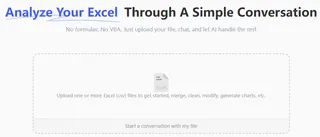
Step 1: Upload Your Data
First, you upload your Excel or CSV files to Excelmatic. You can upload both the "Workshop Registrations" file and the "Members" file. The AI will read and understand the structure of each table.
Step 2: Describe What You Want to Do
Now, you simply chat with the AI. Instead of writing a formula, you type a request. For our example, you could ask:
I have two tables. One is workshop registrations, the other is a member list. Merge them using the 'Member ID' column, and add the 'First Name' and 'Last Name' from the member list to the registration table.
Or more concisely:
Join my registration data with my member data on 'Member ID'.

Step 3: Review and Refine the Result
Excelmatic will instantly perform the lookup and present you with a new, merged table. It understands the logic of joining data based on a common key.
The best part? It's a conversation. You can easily refine the result with follow-up questions:
- "Now, can you filter this table to only show signups for the 'Advanced Python' workshop?"
- "Create a pivot table that counts the number of attendees for each workshop."
- "Add a new column that combines 'First Name' and 'Last Name' into a 'Full Name' column."
This iterative, conversational approach is impossible with static formulas.
Step 4: Export Your Finalized Data
Once you're happy with the result, you can download the newly created table as a clean Excel file. No formulas, no errors, just the data you need, ready to go.
Dialogue Example: Excelmatic in Action
Here’s how that entire process might look in a real conversation with Excelmatic:
User:
I've uploaded two files: registrations.xlsx and members.csv. The registrations file is missing names. Can you help me add them?
Excelmatic:
Of course. I see both files have a 'Member ID' column. I can use this to merge them. I will add the 'First Name' and 'Last Name' columns from members.csv to your registrations.xlsx data. Is that correct?
User: Yes, that's perfect. Please proceed.
Excelmatic: Done. I have generated a new table with the merged data. I also noticed some Member IDs in the registration file that were not in your members list. I have left their names blank. Would you like me to highlight these rows for you?
User: Great idea. Yes, please highlight them in yellow. And then, create a pivot table counting attendees per workshop.
Excelmatic: The rows with missing members are now highlighted. I've also created the requested pivot table. You can view it in the 'Pivot Table' tab and download the complete results as a new Excel workbook.
Traditional Formulas vs. Excelmatic: A Quick Comparison
| Feature | VLOOKUP / XLOOKUP (Manual) | Excelmatic (AI Agent) |
|---|---|---|
| Effort | High: Requires writing, debugging, and maintaining formulas. | Low: Describe your goal in plain language. |
| Required Skill | Intermediate to Advanced Excel knowledge. | Basic ability to describe a business need. |
| Flexibility | Low: Changing requirements means rewriting formulas. | High: Instantly refine or change analysis via conversation. |
| Error Handling | Manual (IFERROR) or built-in but limited. |
Proactive: AI can identify and flag inconsistencies for you. |
| Speed | Minutes to hours, depending on complexity and errors. | Seconds to minutes. |
FAQ
1. Does Excelmatic just write an XLOOKUP formula for me? No, Excelmatic performs the data analysis on the backend. While the result is the same as a successful lookup, it doesn't just generate a formula. It directly creates the final, merged dataset. This means you don't have to worry about formula compatibility or complexity in your final file.
2. What if my common columns have different names (e.g., 'Member ID' vs. 'CustomerID')? You can specify this in your request! For example: "Join my registrations table with my customers table, using 'Member ID' from the first table and 'CustomerID' from the second." The AI is designed to handle these real-world inconsistencies.
3. Is it safe to upload my company's data to Excelmatic? Data privacy and security are top priorities. Excelmatic uses industry-standard encryption and security protocols. For specific details on data handling and privacy, always refer to the official privacy policy on the website. Your data is not used for training models.
4. Can Excelmatic merge more than two tables at once? Yes. If you have data spread across three or more files (e.g., registrations, member details, and payment status), you can describe the multi-step join you need, and the AI will orchestrate the consolidation.
5. I'm a complete Excel beginner. Is Excelmatic for me? Absolutely. In fact, it's an ideal tool for beginners. It allows you to perform powerful data analysis that would normally require significant Excel expertise. If you can explain what you want to a colleague, you can use Excelmatic.
Get Started: Upgrade Your Excel Workflow Today
For years, we've been taught that working with data in Excel means wrestling with formulas. VLOOKUP was a painful necessity, and XLOOKUP was a welcome relief, but both are just tools in a manual process.
The emergence of Excel AI agents represents a fundamental shift. It's time to move beyond the syntax and focus on the substance. Instead of spending your valuable time debugging a broken lookup, you could be asking deeper questions about your data and getting instant answers.
Stop the formula frustration. Upload a spreadsheet you're working on right now and see how much faster you can get to the finish line.
Try Excelmatic for free and merge your first table in seconds.