Key takeaways:
- Traditional what-if analysis using Excel's Goal Seek tool is a manual, multi-step process for finding a single input, and automating it with VBA is too complex for most users.
- Excel AI tools like Excelmatic replace this entire workflow, allowing you to perform goal-seeking analysis by simply describing your objective in natural language.
- With Excelmatic, you can instantly find break-even points or financial targets, explore multi-variable scenarios conversationally, and get results in seconds, saving significant time and reducing manual errors.
Problem Background & Pain Points
Imagine you're a product manager finalizing the business case for a new product. You have a financial model in Excel that calculates the projected profit based on several key inputs: the selling price per unit, the variable cost per unit, the total fixed costs, and the number of units sold.
The big question from leadership is always the same: "What's our break-even point?" In other words, how many units do we need to sell to cover all our costs and achieve a profit of exactly zero?
Answering this seemingly simple question in Excel can be surprisingly frustrating. You could start manually plugging different numbers into the "Quantity Sold" cell, watching the "Profit" cell until it gets close to zero. This is tedious, imprecise, and unprofessional. Or, you could use a specific, somewhat hidden feature built for this exact purpose. But as we'll see, even the "correct" way has its own set of problems, especially when the questions get more complex:
- "What if our fixed costs increase by 10%? What's the new break-even quantity?"
- "If we want to hit a $50,000 profit target, how many units must we sell?"
- "How does our required sales volume change if we adjust the price?"
These are all "goal-seeking" problems. You know the desired outcome (the goal), and you need to find the right input to achieve it. For financial analysts, sales managers, and even individuals managing a personal budget, this type of what-if analysis is a constant, time-consuming task.
The Traditional Excel Solution: The Goal Seek Method & Its Limits
The classic Excel solution for this is the Goal Seek tool. It's part of Excel's "What-If Analysis" suite, designed to work backward from a result to find the required input.
Let's use the break-even analysis example. Your worksheet might have formulas like this:
- Revenue (C5):
=C1*C2(Price * Quantity) - Total Costs (C6):
=C4+(C3*C2)(Fixed Costs + (Variable Cost * Quantity)) - Profit (C7):
=C5-C6(Revenue - Total Costs)
To find the break-even quantity, the traditional process is:
Navigate to the
Datatab on the ribbon.Click
What-If Analysisin the Forecast group.Select
Goal Seek.A small dialog box appears with three fields:
- Set cell: You enter the reference to your formula cell,
C7(Profit). - To value: You enter your target goal, which is
0for break-even. - By changing cell: You enter the reference to the input cell you want to adjust,
C2(Quantity Sold).
- Set cell: You enter the reference to your formula cell,
Click
OK, and Excel will run iterations to find a solution.
While functional, this method is plagued with limitations that make it inefficient for modern, fast-paced work environments.
Limitations of the Traditional Approach
- Hidden and Clunky Interface: The tool is buried three levels deep in the ribbon. For infrequent users, simply finding it is a challenge. The pop-up window is rigid and unintuitive.
- Single Variable Only: Goal Seek can only change one input cell at a time. What if you want to know the break-even quantity if you both lower the price and reduce fixed costs? Goal Seek can't answer that. You'd have to use the even more complex Scenario Manager.
- Destructive and Inflexible: When Goal Seek finds a solution, it permanently changes the value in your "By changing cell." If you want to compare different scenarios, you must run Goal Seek, copy the result elsewhere, undo the change (Ctrl+Z), and then run it again with new parameters. It's a clumsy, repetitive cycle.
- Automation is a Nightmare: The original article suggests recording a VBA macro to automate Goal Seek. This is a massive barrier for over 99% of Excel users. It requires enabling the Developer tab, recording steps, and then editing Visual Basic code. This is not a practical solution for business users who just want quick answers.
- Opaque Failure Messages: Sometimes, Goal Seek fails with a message like "Goal Seeking with cell... may not have found a solution." It doesn't explain why. The fix often involves digging into obscure application-wide settings (
File > Options > Formulas) to change "Maximum Iterations" or "Maximum Change," which is far beyond the scope of a typical user.
The New Solution: Using an Excel AI Agent (Excelmatic)
Instead of manually guiding Excel through a rigid, one-variable-at-a-time process, what if you could just state your goal in plain language? This is exactly what Excel AI agents like Excelmatic are designed for. You upload your file and have a conversation with your data.
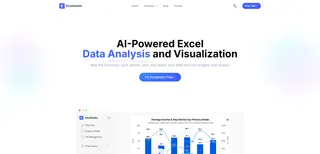
Excelmatic acts as your personal data analyst. It understands the context of your spreadsheet, reads your column headers, and can perform complex calculations—including goal-seeking—based on simple instructions.
Step-by-Step: Solving Goal Seek with Excelmatic
Let's solve the same break-even problem using a modern, conversational approach.
1. Upload Your Data File
First, simply drag and drop your Excel file containing the financial model onto the Excelmatic platform. It supports Excel (.xlsx, .xls) and CSV files. Excelmatic creates a secure, sandboxed environment, so your original file is never modified.
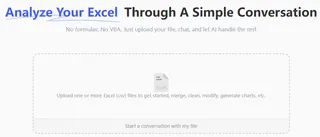
2. Describe Your Goal in Natural Language
Instead of navigating menus and filling out dialog boxes, you just type your question into the chat interface. Here are a few examples of prompts you could use for our break-even scenario:
- "Based on my sheet, what does the 'Quantity Sold' in cell C2 need to be for the 'Profit' in cell C7 to be $0?"
- "Find the break-even point by changing the quantity sold."
- "I want to achieve a profit of $50,000. How many units do I need to sell?"

3. Get Instant Answers and Iterate with Follow-up Questions
Excelmatic will instantly perform the calculation and give you a direct answer. But the real power lies in the ability to iterate and explore scenarios conversationally. This is where it leaves the traditional Goal Seek tool far behind.
You can ask follow-up questions to explore different possibilities without ever touching the spreadsheet manually again.
- "What if the 'Fixed Costs' increase to $80,000? What's the new break-even quantity?"
- "Create a table showing the required 'Quantity Sold' to break even for selling prices of $550, $600, and $650."
- "Now, plot that relationship on a line chart."
4. Export Your Results
Once you have the answers you need, you can download the results. This could be a new Excel file with the calculated values, a table summarizing your scenario analysis, or a chart you can paste directly into a presentation.
Dialogue Example: What-If Analysis in Action
Hvideo autoplay loop muted playsinlinepical conversation with Excelmatic might look to solve our business problem:
User: I've uploaded my product launch P&L. Can you tell me how many units I need to sell to break even? The profit is in cell C7 and the quantity is in cell C2.
Excelmatic: To achieve a profit of $0 (break-even), you need to sell 139 units. This is based on your current selling price of $600 and fixed costs of $75,000.
User: That's helpful. What if we can lower our fixed costs to $65,000? What's the new break-even quantity?
Excelmatic: With fixed costs reduced to $65,000, the new break-even quantity is 121 units.
User: Great. Now, can you create a chart showing how the required break-even quantity changes as the selling price moves from $500 to $700 in $50 increments? Assume fixed costs are back at $75,000.
Excelmatic: Certainly. I have generated a line chart that visualizes the relationship between selling price and the required break-even quantity. As the price increases, the number of units you need to sell to break even decreases. You can download this chart and the underlying data table.
Traditional Goal Seek vs. Excelmatic: A Quick Comparison
| Feature | Traditional Goal Seek | Excelmatic (Excel AI) |
|---|---|---|
| Method | Clicks, menus, dialog boxes | Natural language conversation |
| Flexibility | Single input variable only | Multi-variable scenarios, easy iteration |
| Speed | Slow, repetitive for multiple scenarios | Instant answers, rapid scenario testing |
| Automation | Requires complex VBA macros | No code needed; just ask |
| Usability | Requires specific Excel knowledge | Accessible to anyone who can ask a question |
| Output | Overwrites a single cell in place | Generates tables, charts, and downloadable files |
FAQ
Q: Do I need to know the exact cell references to use Excelmatic?
A: No. While you can use cell references like "C7", it's often easier to use the column or row headers. For example, you can just say "make Profit zero by changing Quantity Sold," and the AI will understand.
Q: Can Excelmatic handle financial models more complex than a simple break-even analysis?
A: Yes. Excelmatic can analyze any data model where the relationships between inputs and outputs are defined by formulas. It can be used for loan calculations, investment projections, sales commission models, and more.
Q: Is my company's financial data safe when I upload it to Excelmatic?
A: Yes. Excelmatic is built with data security as a top priority. Your files are processed in a secure, isolated environment and are not used for training models. For detailed information, always refer to the official privacy policy and security documentation.
Q: Does Excelmatic change my original Excel file?
A: No. Excelmatic never modifies your original uploaded file. It works on a copy of the data within its secure platform, and you can choose to download the results as a new file.
Q: What happens if Excelmatic can't find a solution?
A: Unlike Excel's cryptic error messages, Excelmatic will typically explain why a solution might not be possible based on the model's constraints (e.g., "Even with zero quantity sold, the profit is negative due to fixed costs"). This allows you to refine your model or your question.
Q: Can I use this for personal finance, like the savings goal example?
A: Absolutely! You can upload a personal budget spreadsheet and ask questions like, "For my savings to be 15% of my income, what does my total income need to be?" or "If I cut my 'Dining Out' expense in half, what will my new savings rate be?"
Get Started: Elevate Your Excel Workflow with Excelmatic
Every minute you spend fumbling with menus, manually plugging in numbers, or trying to debug a macro is a minute you're not spending on strategic analysis. The traditional Goal Seek tool, while once useful, is a relic of a pre-AI era.
By embracing an Excel AI agent, you transform what-if analysis from a tedious chore into a dynamic conversation. You can test more scenarios, get deeper insights, and answer complex business questions in a fraction of the time.
Stop hunting through menus and start asking questions. Try Excelmatic for free today and see how quickly you can get answers from your own financial models. Simply upload a spreadsheet and try one of the prompts from this article.