Key takeaways:
- Manually formatting numbers and dates within text strings using Excel's
TEXTfunction is tedious and error-prone, requiring you to memorize dozens of cryptic format codes. - Excel AI tools like Excelmatic replace this manual work. You can simply describe the desired output in plain language, and the AI generates the correctly formatted text or the necessary formula for you.
- Using Excelmatic not only saves significant time but also improves accuracy and flexibility, allowing you to create dynamic, readable report summaries without writing a single complex formula.
Problem Background & Pain Points
Imagine you're creating a dynamic title for your weekly sales report. You have the current date in cell A1 and you want a cell to display "Weekly Sales Summary for May 21, 2025". A simple task, right?
So you try the obvious approach, using the ampersand (&) to join the text and the date cell:
="Weekly Sales Summary for " & A1
But instead of the beautifully formatted date you expected, Excel gives you this:
"Weekly Sales Summary for 45433"
What is "45433"? It's Excel's internal serial number for May 21, 2025. When you combine a formatted cell with a text string, Excel defaults to the raw, unformatted value, leaving your report looking unprofessional and confusing.
This frustrating problem isn't limited to dates. It happens anytime you need to embed a formatted number into text:
- Displaying a percentage in a sentence: "Sales grew by 25% this quarter."
- Formatting currency: "The total invoice amount is $15,250.50."
- Adding leading zeros to an ID: "Employee ID: 001234."
- Formatting a phone number: "Contact us at (555) 123-4567."
In all these cases, simply concatenating the values will strip away the crucial formatting, forcing you to find a more complex solution.
The Traditional Excel Solution: Steps and Limitations
For decades, the standard way to solve this in Excel has been the TEXT function. Its job is to convert a numeric value (like a date, number, or percentage) into a text string with a specific format that you define.
The syntax is: =TEXT(value, format_text)
value: The cell or number you want to format (e.g.,A1).format_text: A special code, enclosed in double quotes, that tells Excel how to display the text (e.g.,"mmmm d, yyyy").
Let's see how it solves our initial problem:
="Weekly Sales Summary for " & TEXT(A1, "mmmm d, yyyy")
This formula correctly produces: "Weekly Sales Summary for May 21, 2024".
Similarly, you can use it for other scenarios:
- Leading Zeros: To format the number
1234in cellA2as001234, you'd use=TEXT(A2, "000000"). - Phone Numbers: To format
5551234567in cellA3as(555) 123-4567, the formula is=TEXT(A3, "(###) ###-####").
The Limitations of the Traditional Way
While the TEXT function works, it's a prime example of a solution that is powerful but far from user-friendly. Here’s why it causes so much friction for Excel users:
- Memorization Hell: To use
TEXTeffectively, you need to know the specific format codes. Is it"m/d/yy"or"dd/mm/yy"? Is it"mmmm"for the full month name or"mmm"for the abbreviation? What's the difference between0and#as placeholders? This requires constant lookups and cognitive overhead. - Complex and Brittle Formulas: If you need to combine multiple formatted values, the formula quickly becomes a long, nested mess. For example:
="On " & TEXT(A1, "mm/dd/yy") & ", sales for " & B1 & " reached " & TEXT(C1, "$#,##0.00") & ".". A single misplaced quote or comma will break the entire thing. - Difficult to Maintain: Imagine your company decides to change its date reporting standard from
MM/DD/YYYYtoDay, Month DD, YYYY. You now have to hunt down every singleTEXTformula in your workbook and manually update the format code. This is time-consuming and prone to error. - High Barrier for Beginners: For team members who aren't Excel power users, these formulas are intimidating and create a barrier to them updating or building reports.
You end up spending more time wrestling with syntax than you do analyzing your data.
The New Approach with Excel AI (Featuring Excelmatic)
What if you could skip the formulas and format codes entirely? What if you could just tell Excel what you want in plain language? That's exactly what Excel AI agents like Excelmatic are designed for.
Excelmatic is a chat-based assistant for your spreadsheets. You upload your Excel or CSV file, and then you can ask it to perform tasks—like formatting text—just by describing the outcome you want.

Step-by-Step Guide to Formatting Text with Excelmatic
Let's solve the same problems using a simple, conversational workflow.
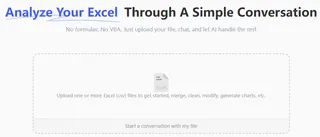
1. Upload Your Data File
First, drag and drop your Excel file containing the raw, unformatted data (dates, numbers, IDs, etc.) into Excelmatic. The AI will read your table and understand the column headers.
2. Ask in Plain Language
Instead of writing a formula, you simply type your request into the chatbox. Here are a few examples based on the scenarios above:
- For Dates: "Create a new column called 'Report Title' that combines the text 'Weekly Sales Summary for ' with the date from the 'Sale Date' column, formatted as 'Month Day, Year'."
- For Leading Zeros: "Take the 'Employee ID' column and reformat all numbers to have 6 digits, adding leading zeros where necessary."
- For Phone Numbers: "Format the numbers in the 'Contact Number' column to look like (###) ###-####."
- For a Complex Summary: "Create a new column named 'Summary'. For each row, generate a sentence that says 'On [Sale Date formatted as dd-mmm-yy], sales for [Sales Rep] were [Amount formatted as $#,##0.00]'."

3. Review and Iterate
Excelmatic will instantly process your request and show you the new column with the correctly formatted text. The beauty of the conversational interface is that you can easily refine the result.
Don't like the format? Just ask for a change:
- "Actually, use the full month name in the date."
- "Can you change the currency to have no decimal places?"
- "Use a dash instead of a slash in the date format."
This iterative process of refinement is impossible with static formulas and saves a tremendous amount of time.
4. Export the Result
Once you're happy with the outcome, you can download a new Excel file containing the perfectly formatted data. You can also ask Excelmatic to provide the traditional TEXT formula it used, which you can then copy and paste into your original workbook if needed.
Dialogue Example
Here’s what a typical conversation in Excelmatic looks like:
User: I have a table with 'Order Date' and 'Revenue' columns. I need to create a summary sentence for each row like "Order from May 21, 2025 generated $5,350.50 in revenue."
Excelmatic: Done. I've added a new column named 'Summary' with the formatted text you described. I used the 'Month Day, YYYY' format for the date and included a dollar sign and comma separators for the revenue. Would you like to make any adjustments?
User: This is great. Can you create another version in a new column but format the date as YYYY-MM-DD and show the revenue with no currency symbol?
Excelmatic: Of course. I've added a second column named 'Summary_Alt_Format' with the requested changes. You can now download the updated file.
Traditional vs. Excelmatic: A Quick Comparison
| Aspect | Traditional TEXT Function |
Excelmatic (Excel AI) |
|---|---|---|
| Learning Curve | High: Must memorize dozens of format codes. | None: Use plain, natural language. |
| Speed | Slow: Manual typing, testing, and debugging. | Instant: Get results in seconds from one prompt. |
| Flexibility | Rigid: Changing formats requires editing formulas. | High: Easily iterate and adjust with follow-up chat. |
| Error Rate | High: Prone to typos in complex syntax. | Low: The AI handles the syntax and formatting logic. |
FAQ
Do I need to know any Excel format codes to use Excelmatic?
No, not at all. The entire purpose of using Excelmatic for this task is to avoid having to remember or look up codes like "dd-mmm-yyyy". You just describe the format you want in words.
Can Excelmatic generate the TEXT formula for me to use in my own sheet?
Yes. After it generates the result, you can ask, "What formula did you use for that?" Excelmatic will provide you with the exact TEXT function syntax, which you can then copy and use in your offline Excel files. This makes it a great learning tool as well.
Is my data secure when I upload it to Excelmatic? Excelmatic is built with data security as a top priority. Your files are processed securely and are not used for training models. For detailed information, please refer to the official privacy policy and security documentation on the website.
What if my data has inconsistent formats to begin with? Excelmatic is quite good at interpreting various data types, even if they're a bit messy. For best results, it's always good to have clean column headers. If the AI is unsure, it may ask you for clarification, which is another advantage over rigid formulas.
Is Excelmatic only for formatting text? No, this is just one of thousands of tasks it can handle. You can use it to generate complex formulas, create pivot tables and charts, clean data, merge datasets, and build entire reports, all through natural language conversation.
Take Action: Upgrade Your Excel Workflow with Excelmatic
Stop wasting time searching for format codes and debugging long, complicated TEXT formulas. The minutes you spend on these tedious tasks add up to hours of lost productivity—hours you could be spending on high-value analysis and decision-making.
By embracing an Excel AI agent, you can transform this frustrating part of your workflow into a simple, two-second conversation. You can build more dynamic, readable, and professional reports with less effort and greater accuracy.
Ready to see the difference? Try Excelmatic for free today. Upload a spreadsheet you're currently working on and use one of the prompts from this article. It's time to let AI handle the syntax so you can focus on what truly matters: your data.