
Key takeaways:
- Many "beginner" Excel tasks like filtering, cleaning text, and creating charts still involve a surprising number of manual steps, clicks, and wizards that are time-consuming and prone to error.
- An Excel AI agent like Excelmatic replaces these multi-step processes with simple, natural language commands, allowing you to clean, analyze, and visualize your data through conversation.
- By using Excelmatic, you can drastically reduce the time spent on routine data preparation and analysis, gain insights faster, and generate reports without memorizing complex functions or menu locations.
Problem background & pain points
For many professionals, Excel is a daily reality. Whether you're tracking sales leads, managing project expenses, or organizing marketing campaign data, you're constantly working with spreadsheets. To get by, most of us learn a set of "beginner tips"—things like using filters, splitting text into columns, or creating a basic chart.
But let's be honest: are these tasks ever truly "simple"?
Imagine you've just downloaded a raw data export. It's a mess. A single column mixes customer names with their ID numbers. Dates are in the wrong format. You need to present a summary of sales for a specific region by the end of the hour.
Your mental checklist kicks in:
- Use the "Text to Columns" wizard to split the customer data.
- Apply filters to isolate the correct region and time frame.
- Maybe use the "Group" feature to create subtotals by product.
- Copy and paste the summarized data into a new sheet.
- Finally, insert a chart and hope it looks presentable.
Each step involves navigating different tabs on the Ribbon, clicking through multiple dialog boxes, and carefully selecting the right cells. A single wrong click can mess up your data. If your boss asks for a slight change—"Can you show me this by salesperson instead of by region?"—you often have to start all over again. These "basic" tasks quickly become a tedious, repetitive, and stressful cycle.
The Traditional Excel Solution: A Multi-Step Manual Process
The traditional approach to tackling the scenario above relies on a series of disconnected tools built into Excel. While powerful, they require you to act as the project manager, manually executing each step in the correct sequence.
Let's break down the typical workflow for cleaning and analyzing a raw sales data sheet.
Step 1: Cleaning Data with "Text to Columns" and "Paste Special"
Your raw data often comes in a format that isn't ready for analysis. For instance, a column named CustomerInfo might contain "John Doe, CUST-101".
- Highlight the Column: You select the entire column you need to split.
- Open the Wizard: You navigate to the
Datatab and clickText to Columns. - Choose Delimiter: In the pop-up wizard, you specify that you want to split the data using a delimiter, like a comma.
- Finish and Adjust: You complete the wizard, and Excel places the split data into adjacent columns. You then have to manually insert new columns and add headers like "Customer Name" and "Customer ID".
Sometimes, you also need to copy data without its messy formatting. This requires using Paste Special > Values, another multi-click operation to ensure you're only moving the raw information.
Step 2: Filtering and Summarizing Data
Once the data is clean, you need to find the specific information you're looking for.
- Apply Filters: You select your data range and go to the
Datatab to click theFiltericon. Drop-down arrows appear on your headers. - Select Criteria: You click the arrow on the 'Region' column, deselect all, and then check the box for "North". You repeat this for the 'Date' column to select a specific quarter.
- Group and Subtotal (Optional): For a more structured summary, you might use the
Subtotalfeature (under theDatatab). This involves sorting your data first, then opening another dialog box to specify that you want to sum the 'Sales' amount every time the 'Product' changes. This adds collapsible groupings to your sheet.
Step 3: Visualizing with a Chart
With your filtered data, you can now create a chart.
- Select Data: You carefully highlight the summarized rows and columns.
- Insert Chart: Go to the
Inserttab, choose a chart type (e.g., Column or Bar), and Excel generates a basic visual. - Format the Chart: You then spend several minutes adjusting the chart title, axis labels, colors, and data labels to make it clear and professional.
The Limitations of the Manual Method
This "traditional" workflow, while functional, is riddled with inefficiencies:
- Time-Consuming: Each step is a manual process. A simple request can take 15-30 minutes of clicking, navigating, and formatting.
- Error-Prone: It's easy to select the wrong range, apply an incorrect filter, or break a formula when moving data around.
- Rigid and Inflexible: What if you need to analyze by 'Salesperson' instead of 'Region'? You have to undo your filters and subtotals and start the process again. Answering follow-up questions is slow.
- High Cognitive Load: You have to remember where each tool is located in the Excel ribbon and the specific steps for each wizard. It distracts you from the actual goal: gaining insights from your data.
The New Solution: Using an Excel AI Agent (Excelmatic)
Instead of being a manual operator of Excel's tools, what if you could just be the director? This is the power of an Excel AI Agent like Excelmatic. You upload your file and tell the AI what you want in plain English. It handles all the tedious steps in the background.
Let's solve the exact same problem using Excelmatic.

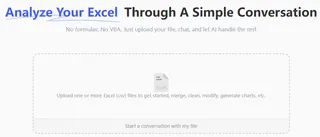
Step 1: Upload Your Data
First, you simply drag and drop your messy Excel or CSV file directly into Excelmatic. The AI instantly reads your data and shows you a preview. You don't need to do any initial cleanup.
Step 2: Describe What You Want in Plain Language
Instead of clicking through menus, you just type your requests into the chat interface. You can perform all the steps from the traditional method in a single, evolving conversation.
Here are some example prompts you could use:
- To clean the data: "In the 'CustomerInfo' column, split the text by the comma into two new columns named 'Customer Name' and 'Customer ID'."
- To filter and summarize: "Show me the total sales for the 'North' region for Q3 2025."
- To group and rank: "Now, group these results by 'Product' and show me the top 5 products by sales."
- To create a chart: "Create a bar chart visualizing the sales for these top 5 products."

Step 3: View and Iterate on the Results
Excelmatic doesn't just give you a final answer. It performs the task and shows you the result—whether it's a new table, a pivot table, or a chart. The best part is that you can continue the conversation to refine it.
This "dialogue-driven" analysis is where the real power lies. It's something impossible with the traditional method.
A Sample Conversation with Excelmatic
Here’s how that workflow could look in a real conversation:
User: I've uploaded my raw sales data. The 'CustomerInfo' column is messy. Can you split it at the comma into 'Customer Name' and 'Customer ID' columns?
Excelmatic: Done. I have created two new columns, 'Customer Name' and 'Customer ID', with the split data. The original column has been kept for reference.
User: Great. Now, filter this table to only show sales from the 'North' region that occurred in the third quarter of 2024. Then, calculate the total sales amount.
Excelmatic: I have filtered the data as requested. The total sales for the North region in Q3 2024 is $157,284. Here is the filtered table.
User: Perfect. Can you create a bar chart that shows the sales breakdown by 'Product Category' for this filtered data?
Excelmatic: Of course. Here is a bar chart showing the sales for each product category in the North region during Q3 2024. You can download this chart as an image or get the entire report as a new Excel file.
Step 4: Export Your Results
Once you're happy with the analysis, chart, or report, you can download the result as a brand new, clean Excel file. You can also ask Excelmatic for the specific formula it used, so you can learn from it or apply it in another workbook.
Traditional Method vs. Excelmatic: A Quick Comparison
| Aspect | Traditional Excel Method | Excelmatic (AI Agent) |
|---|---|---|
| Time | 15-45 minutes of manual clicking and formatting. | 2-5 minutes of typing conversational prompts. |
| Flexibility | Rigid. Changes require re-doing most steps. | Highly flexible. Easily pivot or refine with follow-up questions. |
| Error Rate | High. Prone to human error in selection and filtering. | Low. AI consistently applies logic across the entire dataset. |
| Skill Level | Requires knowledge of various tools and their locations. | Requires only the ability to describe your business need. |
FAQ
1. Do I need to be an Excel expert to use Excelmatic?
Not at all. Excelmatic is designed for users of all skill levels. If you can describe what you want to do with your data in plain language, you can use it. It's especially powerful for beginners who want to perform complex tasks without learning formulas like VLOOKUP or SUMIFS.
2. Is my data safe when I upload it to Excelmatic? Yes. Excelmatic is built with data security as a top priority. Your files are encrypted during transit and at rest, and are not used for training any AI models. For specific compliance needs, always refer to the official privacy policy.
3. Will Excelmatic modify my original Excel file? No. Your original file is never modified. Excelmatic works on a copy of your data in a secure environment. You can then download the results as a new Excel file, leaving your original data untouched.
4. Can Excelmatic handle really messy data? It's very effective at handling common data messes, like extra spaces, inconsistent formatting, or data that needs to be split or combined. For extremely unstructured data, you might need to ask a few sequential questions to clean it up step-by-step, which is still far faster than doing it manually.
5. Can I use the formulas or charts generated by Excelmatic in my own work? Absolutely. You can ask Excelmatic to provide the exact formula it used to generate a result. You can then copy this formula and use it in your own spreadsheets. Likewise, any generated charts or tables can be downloaded and incorporated into your reports.
Get Started Now: Upgrade Your Excel Workflow with Excelmatic
Stop letting tedious, repetitive tasks drain your productivity. The "beginner tips" that once defined Excel proficiency are now being automated, freeing you to focus on what truly matters: the insights hidden in your data.
Instead of spending another hour manually cleaning and filtering your next report, give Excelmatic a try. Upload a spreadsheet you're working on right now and ask it to do the heavy lifting for you. Start with a simple prompt like one from this article and see how quickly you can get to your desired result.
Try Excelmatic for free today and transform your relationship with spreadsheets forever.