
Key takeaways:
- Manually updating Excel chart ranges for recent data (like the last 3 months) is tedious and relies on complex, error-prone formulas such as
OFFSETandCOUNTA. - An Excel AI tool like Excelmatic eliminates this manual work. You can create a self-updating chart by simply asking in plain language, "Chart the sales for the most recent 3 months."
- Using Excelmatic not only saves hours of setup and maintenance time but also increases accuracy and makes your reports far more flexible for handling ad-hoc analysis requests.
Problem Background & Pain Points
Imagine you're a sales manager or financial analyst, and a key part of your job is presenting the latest performance trends to leadership. You have a master Excel sheet where you diligently add the new sales figures at the end of each month.
Your dashboard has a beautiful chart that's supposed to show a rolling quarterly view—that is, the performance of the last three months. But here's the recurring problem: every time you add a new month's data, the chart doesn't update. It still shows the previous three months.
So begins the familiar, frustrating ritual. You right-click the chart, navigate to "Select Data," and manually adjust the data range to include the new month and exclude the oldest one. It's a small task, but you do it every single month. It's repetitive, it's easy to forget, and showing a chart with outdated data in a critical meeting can be embarrassing. This seemingly simple requirement—always showing the latest data—turns into a source of constant, low-level anxiety.
The Traditional Excel Solution: Steps and Limitations
To solve this, seasoned Excel users turn to a "smarter" but significantly more complex method: creating dynamic named ranges. The goal is to define a chart data source that isn't fixed to a static range (like B2:B4) but instead uses a formula to calculate which cells to include.
The most common way to achieve this involves a combination of the OFFSET and COUNTA functions.
How It Works: The Formulaic Approach
Let's say you have your data in two columns: Month (Column A) and Sales (Column B).
To create a chart that always shows the last three months, you would need to:
- Go to the Name Manager: Navigate to the
Formulastab and clickName Manager. - Create a Named Range for Chart Labels (Months):
- Click
New.... - Name it something like
Last3Months_Labels. - In the
Refers to:box, enter this formula:=OFFSET($A$1, COUNTA($A:$A)-3, 0, 3, 1)
- Click
- Create a Named Range for Chart Values (Sales):
- Click
New...again. - Name it
Last3Months_Values. - In the
Refers to:box, enter a similar formula for the sales column:=OFFSET($B$1, COUNTA($B:$B)-3, 0, 3, 1)
- Click
Let's briefly break down what this OFFSET formula does:
OFFSET($A$1, ...): It starts from cell A1....COUNTA($A:$A)-3, ...: It counts all the non-empty cells in column A (e.g., 12 months) and subtracts 3 to find the starting row for our 3-month block (e.g., it moves down 9 rows to find the 10th month)....0, 3, 1): It then defines a range that is 0 columns away, 3 rows tall, and 1 column wide.
- Update the Chart Source: Finally, you edit your chart's data series. You'd set the Axis Labels to
=YourSheetName!Last3Months_Labelsand the Series Values to=YourSheetName!Last3Months_Values.
Limitations of the Traditional Method
While this technique works, it's far from perfect. It's a classic example of forcing Excel to do something it wasn't natively designed for, leading to several real-world problems:
- High Complexity: The
OFFSETfunction is notoriously difficult for most users to understand, debug, and maintain. If it breaks, finding the error is a nightmare. - Volatility:
OFFSETis a "volatile" function. This means it recalculates every single time any cell in the workbook changes, which can significantly slow down large and complex spreadsheets. - Brittleness: The
COUNTAlogic is fragile. If you have a blank row in your data or a subtitle above your table, the count will be wrong, and your chart will display incorrect data. - Poor Scalability: What if your boss asks to see the "last 6 months" instead? You have to go back to the Name Manager, dig up those cryptic formulas, and carefully edit the "3" to a "6" in two different places. Want to filter by region too? That requires a whole new level of formula wizardry.
- Knowledge Silo: The person who set this up becomes the only one who can fix it. It’s not intuitive for new team members to take over.
The New Solution: Using an Excel AI Agent (Excelmatic)
Instead of wrestling with formulas, what if you could just tell Excel what you want? That's the promise of Excel AI agents like Excelmatic. You can solve the exact same problem without writing a single formula.

Excelmatic is an AI tool where you upload your spreadsheet and use a chat interface to ask for analysis, charts, and reports. The AI handles all the underlying complexity.
Step-by-Step: Creating a Dynamic Chart with Excelmatic
Here’s how you'd create the same self-updating "last 3 months" chart in a fraction of the time.
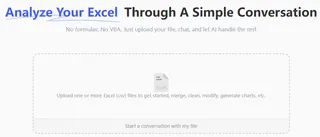
1. Upload Your Data File
First, log in to Excelmatic and upload your Excel file containing the monthly sales data. You can simply drag and drop the file onto the dashboard. The AI will read your spreadsheet and show you a preview.
2. Describe the Chart You Want in Plain Language
Now, instead of opening the Name Manager, you just type your request into the chat box. You can be direct and specific.
Here are a few examples of prompts you could use:
- "Create a column chart showing the sales for the last 3 months."
- "Based on the data, generate a bar chart for the most recent quarter's sales."
- "I need a line chart of sales, but only include the latest 3 months from the dataset."

3. Review and Iterate on the Result
Excelmatic will instantly generate the chart based on your request. But the real power lies in the conversational follow-up. You can easily refine the result.
Maybe you want to add more context or change the view. You can simply ask:
- "Great. Now change the title to 'Rolling 3-Month Sales Performance'."
- "Actually, can you show me the last 6 months instead?"
- "Add data labels to each column."
- "What was the total sales amount for these three months?"
This conversational approach makes analysis fluid and intuitive, turning a rigid report into a flexible analytical tool.
4. Export Your Results
Once you're happy with the chart, you can download a new Excel file. This file will contain the chart you created, ready to be copied into your main dashboard or presentation.
Dialogue Example: User vs. Excelmatic
Here’s how a typical conversation might look:
User: I've uploaded my monthly sales report. Can you create a column chart that always shows the sales for the latest 3 months?
Excelmatic: Of course. I have created a column chart displaying the sales for the last three entries in your data: April, May, and June. The chart is now ready. Would you like to change the chart type or add a trendline?
User: This is perfect. Can you also create a dynamic title for the chart that says "Latest 3-Month Sales Performance"?
Excelmatic: The chart title has been updated. You can download the Excel file with the dynamic chart now.
Traditional vs. Excelmatic: A Quick Comparison
| Aspect | Traditional Method (OFFSET) |
Excelmatic AI Method |
|---|---|---|
| Time to Create | 15-30 minutes (including debugging) | Less than 1 minute |
| Required Skills | OFFSET, COUNTA, Name Manager |
Simple, conversational language skills |
| Flexibility | Very low. Changes require formula rewrites. | Very high. Just ask a new question. |
| Error Rate | High. Prone to errors from typos or data changes. | Extremely low. The AI handles the logic. |
| Maintenance | Difficult. A "black box" for most users. | Zero. Just re-run the prompt on new data. |
FAQ
1. Do I need to understand complex formulas like OFFSET to use Excelmatic?
No, not at all. The entire purpose of Excelmatic is to replace the need for complex formulas with plain language instructions. You just describe the outcome you want.
2. Will Excelmatic modify my original Excel file? No. Excelmatic works on a copy of your data in a secure cloud environment. Your original file remains untouched on your computer. You can download the results as a new file.
3. What if my data isn't perfectly clean, like having empty rows?
This is a major advantage of an AI approach. While a rigid formula like COUNTA would break, Excelmatic's AI is designed to understand the context of your data. It can often correctly identify the "last 3 months" even with imperfections in the sheet.
4. Can I use the chart created by Excelmatic in my existing dashboard? Yes. You can download the new Excel file generated by Excelmatic and simply copy and paste the chart into your own dashboard or presentation, just like any other Excel chart.
5. Is it safe to upload my company's sensitive sales data? Excelmatic is built with enterprise-grade security in mind. All data is encrypted in transit and at rest. For specific details, always refer to the official privacy policy and security documentation on the website.
6. Can Excelmatic handle more complex dynamic requests? Absolutely. You can easily add more conditions to your prompt, such as: "For the 'North' region only, create a line chart showing the sales for the last 3 months." This level of on-the-fly filtering is extremely difficult to achieve with traditional dynamic named ranges.
Take Action: Upgrade Your Excel Workflow Today
Stop wasting valuable time wrestling with the Name Manager and debugging volatile formulas. Every minute you spend manually updating a chart is a minute you're not spending on actual analysis and strategy.
The traditional method is a brittle, time-consuming workaround. The modern solution is to let AI handle the tedious mechanics so you can focus on the insights. Imagine being able to answer any follow-up question about your data instantly, just by asking.
Ready to see for yourself? Try Excelmatic today and upload one of your own monthly reports. Use a prompt from this article and watch it build your dynamic chart in seconds. Your reporting process will never be the same.