
Key takeaways:
- Traditional Excel date calculations require you to learn and combine over 20 different functions like
DATEDIF,NETWORKDAYS, andEOMONTH, a process that is time-consuming, complex, and prone to errors. - Excel AI tools like Excelmatic eliminate this complexity by allowing you to use simple, natural language prompts. You can ask directly: "Calculate the number of business days between Date A and Date B, excluding holidays."
- By using Excelmatic for date-based analysis, you can save significant time, drastically reduce formula errors, and empower team members who aren't Excel formula experts to perform complex calculations with confidence.
Problem Background & Pain Points
If you work in project management, HR, or finance, you know that your world revolves around dates. Project deadlines, employee anniversaries, contract expirations, and payment schedules are the lifeblood of your operations. Excel is the go-to tool for tracking this information, but when it comes to performing calculations, things get complicated—fast.
Imagine you're a project manager with a spreadsheet listing dozens of tasks, each with a start and end date. Your manager asks a seemingly simple question: "How many working days are left for each task, considering our company holidays and that the engineering team works a compressed week from Monday to Thursday?"
Or perhaps you're in HR, preparing an annual report. You need to calculate the precise age and tenure (in years, months, and days) for every employee in the company.
In these common scenarios, you're faced with a familiar dread. Which Excel function do I use? Is it DAYS or DATEDIF? Or do I need NETWORKDAYS? Wait, our work week is non-standard, so it must be NETWORKDAYS.INTL. What was that syntax again? You find yourself searching online, piecing together cryptic formulas, and hoping you didn't miss a comma or a closing parenthesis. This manual, function-heavy approach is not just tedious; it's a minefield of potential errors.
The Traditional Excel Solution: A Maze of Functions
For decades, the only way to tackle these problems was to become a master of Excel's extensive library of date and time functions. While powerful, this approach has significant drawbacks. Let's look at how you'd solve our problems the "old way."
The Challenge: Calculating Workdays with Custom Rules
To find the number of working days between two dates, you can't just subtract one from the other. You need to account for weekends and public holidays.
The standard function is NETWORKDAYS, but since our scenario involves a custom work week (Monday-Thursday), we need its more complex sibling, NETWORKDAYS.INTL.
The formula would look something like this:
=NETWORKDAYS.INTL(start_date, end_date, "0000111", holidays_range)

To make this work, you need to:
- Know that
NETWORKDAYS.INTLis the correct function. - Understand its
[weekend]argument. The"0000111"string is a non-intuitive code where1represents a weekend day (Friday, Saturday, Sunday) and0a workday. - Maintain a separate list of holiday dates in a range (
holidays_range) and reference it correctly in the formula. - Drag this formula down for every task, hoping you've locked your cell references correctly.
The Challenge: Calculating Age or Duration
To calculate an employee's age, you might think of subtracting the birth year from the current year. But that's not accurate. You need a function that understands complete years, months, and days. The go-to function for this is DATEDIF.
The tricky part? DATEDIF is a "hidden" function in Excel. It won't appear in your formula autocomplete list. You have to know it exists and remember its syntax by heart.
=DATEDIF(birth_date, TODAY(), "Y")

"Y"returns the number of complete years."M"returns the number of complete months."D"returns the number of days.
This requires you to write three separate formulas or a complex concatenated string to get a full "Years, Months, Days" output.
Limitations of the Traditional Approach
This function-based method, while effective, is deeply flawed for modern, fast-paced work environments:
- High Learning Curve: You need to memorize the purpose and syntax of over 20 different date functions (
EDATE,EOMONTH,WORKDAY,YEARFRAC, etc.). - Complex and Brittle Formulas: Nesting functions or creating long formulas is common, making them difficult to read, debug, and maintain. A small mistake can lead to a
#VALUE!or#NUM!error. - Inflexible: A formula is built to answer one specific question. If your manager asks a follow-up—"What if we also exclude Fridays?"—you have to start over and rewrite the entire formula.
- Time-Consuming: The cycle of searching for the right function, understanding its syntax, writing the formula, and debugging it consumes valuable time that could be spent on actual analysis.
The New Approach: Using Excel AI with Excelmatic
Instead of forcing you to learn a machine's language (formulas), what if your spreadsheet could understand yours? That's the promise of Excel AI Agents like Excelmatic. You can skip the formula maze and simply describe the outcome you want in plain language.

How It Works
Excelmatic acts as your personal data analyst. The process is simple:
- Upload your Excel or CSV file.
- Chat with the AI, telling it what calculation or analysis you need.
- Review the results—tables, formulas, charts, or reports—generated instantly by the AI.
- Download the completed file, with all the new data and analysis included.
Let's revisit our challenges and solve them the Excelmatic way.
Step-by-Step: Solving Date Calculations with AI
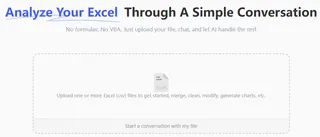
1. Upload Your Data
Start by uploading your spreadsheet containing project tasks or employee records to Excelmatic. Ensure your columns have clear headers like "Start Date," "End Date," or "Birth Date."
2. Ask in Natural Language
Now, instead of writing formulas, you just type your request in the chat box.
To solve the project management problem:
For each task, calculate the number of working days between the 'Start Date' and 'End Date'. Our workdays are only Monday, Tuesday, Wednesday, and Thursday. Also, exclude the list of public holidays in the 'Holidays' sheet.
To solve the HR age calculation problem:
Calculate the current age for each employee using their 'Birth Date' and today's date. Show the result in completed years in a new column called 'Age'.
Other common date calculations:
- Instead of
EDATE: "Create a new column named 'Contract Renewal' that is 36 months after the 'Start Date'." - Instead of
EOMONTH: "Add a column 'Month-End Deadline' that shows the last day of the month for each 'End Date'." - Instead of
YEARFRAC: "Calculate each employee's tenure in years as a decimal value."

3. Review and Refine the Results
Excelmatic will process your request and display a preview of the updated table. The beauty of this conversational approach is that you can easily iterate.
You could follow up with:
- "Great. Now highlight all projects with fewer than 20 working days remaining."
- "Can you also add another column showing the tenure in total months?"
- "Filter this list to only show employees who will have their 10-year anniversary next year."
This iterative analysis is incredibly difficult and time-consuming with traditional formulas but takes only seconds with an AI agent.
4. Export Your Completed File
Once you're satisfied, you can download the new Excel file. It will contain all your original data plus the new columns and analysis you requested, ready to be shared or used in a report.
Example Conversation with Excelmatic
Here’s how a typical interaction might look:
User: I've uploaded a file with employee names and their hire dates. Can you add a column to calculate their tenure in years as of today?
Excelmatic: Done. I've added a 'Tenure (Years)' column by calculating the difference between today's date and the 'Hire Date'. Would you also like to see the tenure in months or days?
User: Yes, add another column for tenure in total months. Also, can you find the date for each employee's 5-year work anniversary?
Excelmatic: Okay, I've added the 'Tenure (Months)' column and a '5-Year Anniversary' column. The anniversary date is calculated by adding 5 years to each hire date. You can download the updated file now.
Traditional vs. Excelmatic: A Quick Comparison
| Task | Traditional Excel Method (Manual) | Excelmatic Method (AI) |
|---|---|---|
| Effort | Research NETWORKDAYS.INTL syntax, find the weekend code, create a holiday range, write and debug the formula. |
Type a single sentence describing the desired outcome. |
| Time | 10-20 minutes for a moderately complex task. | Less than 1 minute. |
| Flexibility | Very rigid. A small change requires a full formula rewrite. | Highly flexible. Easily refine or change requests in conversation. |
| Error Rate | High. Prone to syntax errors, incorrect cell references, and logic flaws. | Low. The AI handles the complex logic, minimizing human error. |
| Accessibility | Requires advanced Excel knowledge. | Accessible to anyone who can describe their business needs. |
FAQ
1. Do I need to know any Excel functions to use Excelmatic? No, not at all. The entire purpose of Excelmatic is to free you from memorizing formulas. You only need to describe what you want in plain English.
2. Is my data safe when I upload it to Excelmatic? Yes. Excelmatic is built with security in mind, employing industry-standard encryption for data in transit and at rest. Your files are processed in a secure environment and are not shared. For specific details, always refer to the official privacy policy.
3. Will Excelmatic change my original Excel file? No. Excelmatic works on a copy of your data in its secure environment. Your original file remains untouched on your computer. You can download the new, modified file once the analysis is complete.
4. What if my dates are stored as text (e.g., "Jan 15, 2024")? Excelmatic's AI is designed to recognize and convert many common date formats stored as text. For best results, it's always good practice to have clean data, but the AI can often handle inconsistencies automatically.
5. Can I get the Excel formula from Excelmatic? Yes. After generating a result, you can ask Excelmatic, "What formula did you use for that calculation?" The AI will provide the exact formula, which you can then copy and use in your own spreadsheets if you wish. This makes it a great tool for learning, too!
6. How is this different from just using ChatGPT? While ChatGPT can help you write formulas, Excelmatic is a dedicated Excel AI Agent. It directly interacts with your data file. It doesn't just give you a formula to copy-paste; it performs the analysis, generates the new columns, tables, or charts, and provides the finished Excel file for download. This integrated workflow is faster, more accurate, and eliminates tedious back-and-forth.
Take Action: Revolutionize Your Excel Workflow Today
Every minute you spend wrestling with DATEDIF or looking up the weekend codes for NETWORKDAYS.INTL is a minute you're not spending on strategic analysis. The old way of working with dates in Excel is powerful, but it's also a bottleneck.
With Excelmatic, you can transform a frustrating, time-consuming task into a simple, two-minute conversation. You can answer complex business questions faster, with greater accuracy, and without needing a PhD in Excel formulas.
Stop the formula struggle. Try Excelmatic today by uploading the very spreadsheet you're working on right now. Use one of the prompts from this article and watch as hours of work get done in seconds.