
Key takeaways:
- Creating a pie chart in Excel manually involves a multi-step process of data selection, menu navigation, and tedious formatting that is time-consuming and rigid.
- Excel AI tools like Excelmatic eliminate these manual steps, allowing you to generate a complete pie chart instantly by simply describing what you need in plain English.
- With Excelmatic, you can conversationally refine your chart—like changing labels, grouping small slices, or exploding a section—achieving in seconds what would take minutes of manual work, boosting both speed and accuracy.
Problem Background & Pain Points
Imagine you're a marketing manager preparing for a quarterly review. You have a spreadsheet with a long list of leads, each attributed to a specific source: 'Organic Search', 'Paid Social', 'Email Marketing', 'Referrals', and so on. Your goal is simple: create a clear, compelling pie chart that shows the percentage contribution of each channel to the total leads.
This should be easy, right? Yet, you find yourself sinking time into a surprisingly fussy process. First, you have to summarize your raw data, perhaps using a pivot table or COUNTIF formulas. Then, you carefully select the summary data, navigate to the Insert tab, find the Charts group, and click the pie chart icon.
But the chart Excel gives you is rarely presentation-ready. The title is generic, there are no percentage labels, the legend is awkwardly placed, and the colors might not match your company's branding. Now begins the endless cycle of right-clicking, exploring the 'Format Data Series' pane, and wrestling with the 'Chart Design' and 'Format' tabs. An hour later, you finally have a decent-looking chart. But then your manager asks, "Can you group the three smallest channels into an 'Other' category and highlight our top channel?" You sigh, knowing you have to go back, rework your summary data, and start the chart-making process all over again.
The Traditional Excel Solution: Steps and Limitations
The classic way to create a pie chart in Excel is a well-trodden path, but it's filled with manual steps and potential frustrations. It's a reliable method, but not an efficient one.
Here’s a summary of the manual process:
Prepare Your Data: A pie chart requires summarized, categorical data. If you have raw data (like a list of sales transactions), you must first create a summary table. This usually involves using a PivotTable or functions like
SUMIForCOUNTIFto get a single value for each category (e.g., total sales per region).Select the Data: Highlight the two columns of your summary table—the category names (e.g., 'Region') and their corresponding values (e.g., 'Total Sales').
Insert the Chart: Go to the
Inserttab on the Excel ribbon. In theChartssection, click the 'Insert Pie or Doughnut Chart' icon and select a basic 2D Pie.Customize and Format: This is where most of the time is spent. Excel's default chart is just a starting point.
- Add Data Labels: Right-click the chart and select 'Add Data Labels'. Then, right-click the labels and choose 'Format Data Labels' to add percentages, category names, and change their position.
- Change Title: Click on the default "Chart Title" to type a more descriptive one.
- Adjust Colors: Use the 'Chart Design' tab to change the color scheme or manually click on each slice to change its fill color.
- Explode a Slice: To emphasize a category, you must click once on the pie to select it, then click a second time on a specific slice, and finally drag it away from the center.
The Limitations of the Manual Method
While functional, this traditional approach has several significant drawbacks:
- Time-Consuming: The process involves numerous clicks and navigations through different menus and side panes. A "quick" chart can easily take 10-15 minutes to perfect.
- Rigid and Inflexible: Making changes is cumbersome. If you need to regroup categories or filter out data, you often have to modify the source data and sometimes recreate the chart from scratch.
- High Margin for Error: Manually selecting data ranges, formatting labels, and adjusting settings increases the chance of mistakes. It's easy to forget to update a range or apply a format incorrectly.
- Steep Learning Curve for Advanced Customization: While creating a basic pie is simple, advanced formatting like conditional colors or dynamic labels requires deep knowledge of Excel's less-intuitive features.
- Poor for Exploratory Analysis: The manual process discourages quick experimentation. You're less likely to explore different views of your data if each view requires a lengthy creation process.
The Excel AI Solution: Using Excelmatic
What if you could bypass all the manual steps and simply tell Excel what you want? That's the power of an Excel AI Agent like Excelmatic. Instead of being a "chart wizard operator," you become a director, telling the AI your desired outcome in plain language.

The New Workflow with Excelmatic
The process is streamlined into a simple conversation. You upload your data, make a request, and get a result.
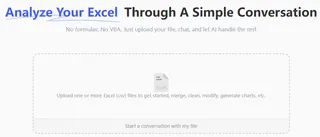
Step 1: Upload Your Data File
Simply drag and drop your Excel or CSV file into Excelmatic. The AI will read your data and show you a preview. It's best to have clear column headers (like "Region" and "Sales") so the AI can easily understand your data structure.
Step 2: Ask for a Pie Chart in Natural Language
Instead of clicking through menus, you just type your request into the chatbox. You can be as simple or as specific as you need.
Here are a few examples based on a sales data file:
- "Create a pie chart showing the total sales for each region."
- "Show me the percentage distribution of sales by product category as a pie chart."
- "Generate a pie chart for the sales quantity per salesperson, and show the percentage on each slice."

Step 3: Review and Iterate with Follow-up Questions
Excelmatic will instantly generate the pie chart. But the real magic is what comes next. You can continue the conversation to refine the chart on the fly.
- "Change the title to 'Q3 Regional Sales Performance'."
- "Explode the 'North' region's slice."
- "Combine the two smallest slices into a category called 'Other'."
- "Now, show this as a doughnut chart instead."
This conversational approach makes data exploration fast and intuitive. You can test ideas and answer follow-up questions from colleagues in real-time, without ever touching a formatting pane.
Step 4: Export Your Results
Once you're happy with the chart, you can download a new Excel file containing the chart and its source data. You can copy-paste it directly into your presentation or report.
Dialogue Example: Creating a Report Chart in Seconds
Here’s a realistic conversation between a user and Excelmatic to create the marketing report chart mentioned earlier.
User: I've uploaded my lead data. Can you create a pie chart showing the percentage of leads from each 'Lead Source'?
Excelmatic: Of course. I have generated a pie chart that displays the lead distribution by source. 'Organic Search' is the largest contributor at 45%. Would you like to make any adjustments?
User: This looks great. Can you change the title to "Q3 Lead Source Distribution"? Also, please combine 'Bing Ads' and 'Referral' into a single slice named 'Other'.
Excelmatic: Done. The title has been updated, and 'Bing Ads' and 'Referral' are now grouped under 'Other'. The new 'Other' category represents 12% of total leads. Is there anything else?
User: Perfect. Please explode the 'Organic Search' slice to highlight it.
Excelmatic: I have exploded the 'Organic Search' slice for emphasis. You can now download the updated Excel file with this chart.
Traditional Method vs. Excelmatic: A Quick Comparison
| Aspect | Traditional Excel | Excelmatic (Excel AI) |
|---|---|---|
| Time to Create | 5-15 minutes | ~30 seconds |
| Flexibility | Low. Changes often require redoing work. | High. Modify instantly with chat commands. |
| Skill Required | Intermediate Excel knowledge (PivotTables, Chart Formatting) | Ability to describe your goal in language skills. |
| Error Rate | Higher due to manual steps. | Lower, as AI handles data aggregation and formatting. |
| Exploration | Discouraged by the slow process. | Encouraged by conversational speed. |
FAQ
Q1: Do I need to be an Excel expert to use Excelmatic? Not at all. If you can describe the chart you want in a sentence, you can use Excelmatic. It's designed for everyone, from beginners who don't know formulas to experts who want to save time.
Q2: Will Excelmatic modify my original Excel file? No. Your original file is used for analysis only and is never modified. You can download the results, including any new charts or tables, as a separate Excel file.
Q3: What if my data is messy? Excelmatic can handle many common data cleaning tasks. You can ask it to "remove duplicate rows," "fill in blank cells with 0," or "trim whitespace from the 'Category' column" before you ask for the chart.
Q4: Can I create other chart types besides pie charts? Absolutely. You can ask Excelmatic to create bar charts, line graphs, scatter plots, and more. Just specify the chart type in your request, for example, "Create a bar chart of sales by month."
Q5: Is my data secure when I upload it to Excelmatic? Data security is a top priority. Excelmatic uses industry-standard encryption for data in transit and at rest. For specific details on privacy and security policies, it's always best to consult the official website.
Q6: Can I customize the colors and styles of the chart? Yes. While the AI provides a clean default design, you can make requests like "use a blue color palette" or "make the data labels bold." For highly specific branding, you can make final tweaks in Excel after downloading the AI-generated chart.
Take Action: Upgrade Your Excel Workflow Today
Stop letting Excel's manual charting process dictate your pace. Every minute spent wrestling with formatting panes is a minute you could have spent uncovering insights from your data. The traditional way is no longer the only way.
By embracing an Excel AI agent like Excelmatic, you transform a tedious task into a quick, creative conversation. You can finally build the exact charts you need, answer ad-hoc questions instantly, and produce professional-quality reports in a fraction of the time.
Ready to see for yourself? Try Excelmatic today. Upload the spreadsheet you're working on right now and use one of the prompts from this article. Experience firsthand how effortless data visualization can be.