
Key takeaways:
- Automating repetitive actions across multiple Excel sheets or files, like formatting or data consolidation, traditionally requires writing and maintaining complex VBA loops, which is time-consuming and error-prone.
- Excel AI tools like Excelmatic replace the need for coding. You can simply describe the repetitive task in plain language, and the AI will execute it across all specified sheets or files automatically.
- Using Excelmatic dramatically reduces setup time from hours to minutes, eliminates debugging frustrations, and allows anyone—not just VBA experts—to build powerful, flexible automations in Excel.
The Challenge: The Endless Grind of Repetitive Excel Tasks
Imagine it's the end of the month. You're a financial analyst responsible for consolidating sales data from 20 different regional branches. Each branch sends you an Excel file, and within each file are sheets for different product lines. Your job is to go into every single sheet, in every single file, to perform a series of identical tasks: calculate the total profit, highlight the top 3 sales, and copy a summary of this data into a master workbook.
Doing this by hand is not just tedious; it's a recipe for disaster. A single copy-paste error or a missed sheet can compromise the entire report. This is the exact scenario that pushes many Excel users towards learning Visual Basic for Applications (VBA), the programming language built into Excel. The goal? To write a script that can loop through all the files and sheets and perform the tasks automatically.
But this path comes with its own set of significant challenges.
The Traditional Solution: Wrestling with VBA Loops
For decades, VBA has been the go-to solution for automating complex, repetitive work in Excel. The core concept used for these tasks is the "loop." A loop is a block of code that repeats an action multiple times.
To solve our consolidation problem, a VBA programmer would typically write a script involving several "nested loops."
How VBA Loops Work (In Theory)
- The Outer Loop (Files): The script would first need a loop to iterate through every Excel file in a specific folder (e.g., the 'Monthly Reports' folder).
- The Middle Loop (Worksheets): Inside that loop, another loop would be needed to go through every worksheet within the currently open file.
- The Inner Loop (Cells/Rows): Often, a third loop is required to process data row by row within each sheet, for instance, to check a condition or apply formatting.
A simplified conceptual structure of such a script might look like this:
' This is a conceptual example of nested loops
Sub ConsolidateAllReports()

    Dim wb As Workbook
    Dim ws As Worksheet

    ' Loop 1: Go through every workbook (file)
    For Each wb In Application.Workbooks

        ' Loop 2: Go through every worksheet in the current workbook
        For Each ws In wb.Worksheets

            ' --- Perform your actions here ---
            ' Example: Find the last row with data
            ' Example: Insert a formula to calculate profit
            ' Example: Copy the summary to a master sheet

        Next ws

    Next wb

End Sub
The Limitations of the VBA Approach
While powerful, this solution is far from perfect and creates a high barrier to entry for most business users:
- Steep Learning Curve: You can't just "pick up" VBA. It requires learning programming fundamentals, understanding the complex Excel Object Model (
Workbook,Worksheet,Range), and mastering syntax. This can take weeks or months. - Time-Consuming to Write and Debug: Writing a robust script with nested loops takes time. More importantly, debugging it when it inevitably fails—because a file is named differently or a sheet has an extra column—is a frustrating and lengthy process.
- Rigid and Hard to Maintain: What happens when the business requirement changes slightly? If your manager asks you to now also calculate the average deal size, you have to go back into the code, modify it, test it, and redeploy it. The script is not flexible.
- High Risk of Errors: A small logical error in the loop (e.g.,
i = i + 1in the wrong place) can lead to infinite loops that crash Excel or, worse, subtle data corruption that goes unnoticed. - Dependency on Experts: The script is often a "black box" understood only by the person who wrote it. If that person leaves the company, the automation breaks and no one knows how to fix it.
The Modern Solution: Automate with an Excel AI Agent (Excelmatic)
Instead of forcing you to become a programmer, what if you could just tell Excel what you want to do in plain language? This is the promise of Excel AI Agents like Excelmatic. It handles the looping, iteration, and execution behind the scenes, allowing you to focus on the business logic.

Let's revisit the same problem of consolidating reports from 20 different files. Here’s how you’d solve it in minutes with Excelmatic.
Step 1: Upload Your Data
First, instead of writing code to open files, you simply upload all 20 Excel files directly to Excelmatic. The platform is designed to handle multiple files at once, automatically recognizing them as a single dataset. You can also upload a single Excel file with many sheets.
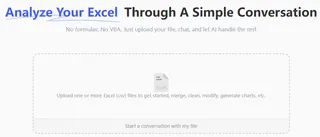
Ensure your column headers are clear (e.g., "Region," "Product," "Sale Amount"), as this helps the AI understand your data structure.
Step 2: Describe Your Repetitive Task in Natural Language
Now, instead of writing loops, you just chat with the AI. You can issue a command that applies to all the data you uploaded, regardless of how many files or sheets it came from.
Here are some example prompts you could use:
- "For each original sheet, calculate the sum of 'Sale Amount' and the average of 'Profit Margin'."
- "Combine all the uploaded files into a single table. Add a new column named 'Source File' that contains the original file name for each row."
- "In the combined data, for each 'Region', find the top 3 rows based on 'Sale Amount'."
- "For all rows, create a new column called 'Commission' which is 5% of the 'Sale Amount' if 'Profit Margin' is greater than 20%, otherwise it's 2%."

The AI parses your request and executes the operation across the entire dataset instantly.
Step 3: Review, Iterate, and Refine
Excelmatic will present the result as a new table. The beauty of the conversational interface is that you don't have to get it perfect on the first try. You can continue refining the result with follow-up questions.
This "dialogue" is where the true power lies, offering a flexibility that VBA scripts can't match.
Example AI Dialogue
Here’s how a typical conversation might look in Excelmatic for our consolidation task:
User: I've uploaded 20 regional sales files. Combine them all into one master sheet. Add a new column called 'Source Region' that shows which file each row came from.
Excelmatic: Done. I have merged all 20 files into a single table with 15,480 rows. A 'Source Region' column has been added.
User: Great. Now, for each region, I only want to see sales for the 'Electronics' category. Please filter the data.
Excelmatic: I have filtered the table to only include rows where the 'Category' is 'Electronics'. The table now has 3,120 rows.
User: Perfect. Now, create a pivot table that shows the total 'Sale Amount' for each 'Sales Rep', broken down by 'Source Region'. Sort the reps by their total sales in descending order.
Excelmatic: I have generated the requested pivot table. You can view it now or download the result. Would you also like a chart to visualize this?
Step 4: Export Your Results
Once you are satisfied with the result—whether it’s a cleaned table, a pivot table, or a chart—you can download it as a new, clean Excel file with a single click. You can also copy the generated formulas or pivot table configurations to use in your existing workbooks.
VBA Loops vs. Excelmatic: A Quick Comparison
| Aspect | Traditional VBA Loops | Excelmatic (AI Agent) |
|---|---|---|
| Time to Implement | Hours or days (writing, testing, debugging) | Minutes |
| Required Skill | VBA programming, Excel Object Model | Basic language skills, understanding of the business task |
| Flexibility | Low. Changes require code modification. | High. Easily adapt with follow-up questions. |
| Error Rate | High. Prone to syntax and logical errors. | Low. AI handles execution and syntax. |
| Maintenance | Difficult. Requires a VBA expert to update. | None. The process is defined by the conversation. |
FAQ
1. Do I need to know any coding to use Excelmatic for automation? No, not at all. Excelmatic is designed for business users. If you can describe your goal in a sentence, you can use the tool. It completely replaces the need for writing VBA, Python scripts, or complex formulas.
2. How does Excelmatic handle tasks that would normally require complex nested loops?
When you issue a command like "For each region, find the top 3 products," the AI engine translates this into the necessary iterative logic on the backend. It understands concepts like grouping (for each region) and ranking (top 3 products) and executes them without you ever seeing a line of code.
3. Is my data safe when I upload it to Excelmatic? Data privacy and security are paramount. Excelmatic uses industry-standard encryption for data in transit and at rest. Your files are processed in a secure cloud environment and are not shared or used for training other AI models. For specific compliance details, always refer to the official privacy policy.
4. Can Excelmatic modify my original files? No. Excelmatic works in a non-destructive way. It treats your uploaded files as a read-only data source. All transformations, calculations, and reports are generated in the platform, and you can download the results as a brand-new Excel file, leaving your original data untouched.
5. Is this just another macro recorder? No. A macro recorder simply records and replays your exact mouse clicks and keystrokes, which makes it extremely brittle. If a column moves or a button's position changes, the macro breaks. Excelmatic understands the intent behind your request (e.g., "sum the sales column"), so it works even if your data structure changes slightly.
Get Started: Upgrade Your Excel Workflow Today
Stop spending valuable hours trapped in the cycle of writing, debugging, and maintaining fragile VBA scripts. The repetitive tasks that drain your productivity are the perfect candidates for AI-powered automation. By switching to a tool like Excelmatic, you're not just saving time—you're empowering yourself and your team to answer complex data questions faster, with more confidence and far less frustration.
Ready to see it in action? Try Excelmatic for free and upload one of your own repetitive tasks. Use the prompts from this article as a starting point and discover a smarter way to work with your data.