Key takeaways:
- Traditional quarterly reporting in Excel often involves tedious, repetitive manual chart creation or relying on fragile, hard-to-maintain macros that break easily.
- Excel AI agents like Excelmatic eliminate this manual work. You can simply upload your data and ask for the specific charts and analyses you need using plain language.
- Using Excelmatic not only saves hours each quarter but also provides the flexibility to instantly modify reports, answer ad-hoc questions, and eliminate the risk of macro errors, all without writing a single line of code.
The Repetitive Grind of Quarterly Reporting
If you work with data, you know the routine. The end of the quarter arrives, and with it comes a fresh batch of data—website analytics, sales figures, operational metrics. Your task is to turn this raw data into a consistent set of reports and charts for management.
Imagine you're a marketing analyst. Every three months, you receive an Excel file with website traffic data broken down by country. The file has separate worksheets for Q1, Q2, Q3, and Q4. For each quarter, you need to create the same two charts:
- A chart comparing New vs. Returning Visits for each country.
- A chart visualizing the proportion of Paid vs. Free accounts in each country.
The first time, it's an interesting task. The second time, it's familiar. By the third and fourth quarters, it's a chore. You find yourself mechanically repeating the exact same clicks, selections, and formatting steps. It's not just tedious; it's a perfect opportunity for human error. What if you accidentally select the wrong data range in Q3? The whole report could be misleading, and you might not even notice.
The Traditional Solution: Excel Macros and Their Hidden Flaws
A seasoned Excel user might say, "This is a perfect job for a macro!" And they're not wrong. Recording a macro is the classic way to automate repetitive tasks in Excel.
The idea is simple: you turn on the Macro Recorder, perform the task once (create the two charts for one worksheet), and then stop the recorder. Excel translates your actions into Visual Basic for Applications (VBA) code. Now, you can simply run this macro on your other quarterly worksheets, and voilà—the charts appear in seconds.
The Steps to Record a Reporting Macro
Here's what that process typically looks like:
- Start Recording: Navigate to the
Developertab and clickRecord Macro. - Create Chart 1 (Visits):
- Select the data range containing 'Country', 'New Visits', and 'Returning Visits'.
- Go to
Insert>Chartsand choose a suitable chart, like a Clustered Column Chart. - Add a title ("New vs. Returning Visits by Country") and axis labels.
- Move the chart to a designated spot on the worksheet.
- Create Chart 2 (Paid Account Proportion):
- This is trickier. You might first need to insert a helper column to calculate the percentage of paid accounts for each country. The formula would be something like
=PaidAccounts / (PaidAccounts + FreeAccounts). - Select the 'Country' column and your new 'Paid Percentage' column.
- Insert a Pie Chart or a Bar Chart to show the proportion.
- Add a title ("Proportion of Paid Accounts by Country") and data labels showing the percentages.
- This is trickier. You might first need to insert a helper column to calculate the percentage of paid accounts for each country. The formula would be something like
- Stop Recording: Click
Stop Recordingon theDevelopertab. - Run on Other Sheets: Go to the Q2, Q3, and Q4 sheets and run the macro.
Why Macros Are a Brittle Solution
While macros seem powerful, they are notoriously fragile and come with significant limitations:
- Brittleness: The macro records exact actions. If the source data for Q3 has an extra column, a different number of rows, or even a slightly different column name, the macro will fail, often with a cryptic VBA error message.
- Lack of Flexibility: Your manager sees the report and asks, "This is great, but can you show the visit data as a stacked bar chart instead? And can we filter out countries with less than 1000 visits?" Your macro can't handle this. You either have to do it manually or record a completely new macro.
- High Maintenance & Learning Curve: If a macro breaks, you can't just "talk" to it to fix it. You need to open the VBA editor and debug the code. This requires learning a programming language, a steep hurdle for most business users who just want to get their reports done.
- Collaboration Nightmare: You go on vacation and a colleague needs to run the quarterly report. The macro fails. They have no idea how it was built or how to fix it, creating a single point of failure and a knowledge silo.
Macros are a solution from a different era. Today, there's a smarter, more flexible way to automate your Excel work.
The New Way: Using Excel AI with Excelmatic
Instead of programming a rigid set of instructions with a macro, what if you could just describe the report you want to an AI assistant? That's the core idea behind Excel AI agents like Excelmatic.
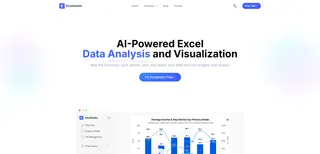
Excelmatic is an AI chat assistant designed for your spreadsheets. You upload your data file, and then, using simple, natural language, you tell the AI what analysis, charts, or reports you need. The AI handles the complex steps for you.
Let's solve the same quarterly reporting problem using Excelmatic.
Step-by-Step: From Raw Data to Full Report in Minutes
1. Upload Your Data File
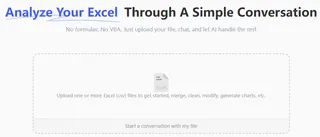
First, drag and drop your Excel workbook—the one with the Q1, Q2, Q3, and Q4 worksheets—directly into the Excelmatic chat interface. The AI will read the file and understand its structure.
2. Describe the Charts You Need in Plain Language
Now, instead of clicking through menus, you just type your request. You can ask for everything at once or go step-by-step.
Here are some example prompts you could use:
- "For the worksheet named 'Q1 Data', create a column chart that shows the New Visits and Returning Visits for each country."
- "On the same 'Q1 Data' sheet, calculate the percentage of paid accounts for each country and visualize it with a pie chart. Title it 'Paid Account Proportion'."
- "Now, please generate the same two charts for the worksheets 'Q2 Data', 'Q3 Data', and 'Q4 Data'."

The AI will process your request and generate the charts, placing them directly in a new, downloadable Excel file.
3. Review and Iterate with Conversation
This is where Excel AI truly shines. The initial charts are just the beginning of a conversation.
Let's say your manager gives you feedback. You can simply continue the chat:
- "That's great. For all the column charts, change them to stacked bar charts."
- "In the Q4 report, can you filter out any countries with fewer than 500 total visits?"
- "Add data labels to all the pie charts showing the percentage value."
Each request is handled instantly. There's no re-recording, no debugging code. This conversational approach makes reporting incredibly fast and flexible.
4. Download Your Completed Report
Once you're happy with the result, you can download the final Excel file. It will contain all your original data, with the newly generated and perfectly formatted charts placed on their respective worksheets.
A Sample Excelmatic Conversation
Here’s how a typical interaction might look:
User: I've uploaded an Excel file with website analytics for four quarters, each in a separate tab (Q1, Q2, Q3, Q4). For each tab, I need two charts:
- A bar chart comparing New and Returning visits by country.
- A pie chart showing the percentage of paid accounts by country.
Excelmatic: I have processed your request. I've created a new Excel file where each quarterly sheet now contains the two charts you specified. The bar chart compares visits, and the pie chart visualizes the paid account proportion. You can download the file now.
User: This looks perfect. For the Q4 report, can you add a title to the bar chart that says "Q4 Website Visits by Country"?
Excelmatic: Of course. The title for the bar chart on the 'Q4' sheet has been updated. The new file is ready for download. Anything else?
Macros vs. Excelmatic: A Quick Comparison
| Feature | Traditional Excel Macro | Excelmatic (Excel AI) |
|---|---|---|
| Setup | Requires manual recording of every click and selection. | Simple text prompt describing the desired outcome. |
| Flexibility | Very rigid. Fails if data structure changes. | Highly flexible. Adapts to changes and new requests. |
| Modification | Requires editing complex VBA code. | Simple follow-up questions in plain language. |
| Skill Level | Basic recording is easy; debugging requires coding. | If you can describe your goal, you can use it. |
| Time Saved | Automates the run, but setup and maintenance are slow. | Saves time on setup, execution, and all future revisions. |
FAQ
Do I need to know VBA or any formulas to use Excelmatic? No, not at all. You only need to be able to describe what you want to achieve in plain language. Excelmatic translates your words into the necessary actions, whether that's creating formulas, pivot tables, or charts.
Will Excelmatic modify my original Excel file? No. Excelmatic works in a secure, non-destructive way. It reads your uploaded file and generates a new Excel file with the results, leaving your original data untouched.
What if my data isn't perfectly clean? Excelmatic is designed to handle common data inconsistencies. For more complex cleaning tasks, you can even ask it for help. For example: "Find all rows where the 'Country' column is blank and remove them."
Can Excelmatic handle multiple worksheets in one file? Yes. As shown in the example, you can simply refer to the worksheets by name in your prompts (e.g., "In the 'Q1 Data' sheet, do...").
Is my company's data safe when I upload it to Excelmatic? Data security is a top priority. Excelmatic uses industry-standard encryption for data in transit and at rest. For specific details on compliance and security protocols, always refer to the official privacy policy on the website.
Start Automating the Smart Way
The era of recording and debugging fragile macros for routine reporting is over. Your time is too valuable to be spent on repetitive clicking or wrestling with VBA code.
By embracing an Excel AI agent like Excelmatic, you transform reporting from a tedious chore into a simple conversation. You can generate your quarterly reports in minutes, not hours, and respond to new requests with agility. The time you save can be reinvested in what truly matters: analyzing the data and uncovering insights that drive your business forward.
Ready to leave macros behind? Try Excelmatic for free today. Upload your next report and see how quickly you can get it done by just asking.