Key takeaways:
- Static Excel templates for business tasks like budgeting, project planning, or invoicing are often rigid, difficult to customize, and rarely fit your unique data and workflow.
- An Excel AI tool like Excelmatic replaces the need for templates by building custom reports, trackers, and calculators directly from your data using natural language prompts.
- This AI-driven approach saves hours of manual customization, reduces formula errors, and creates flexible, dynamic solutions that can be updated instantly with a simple chat command.
The Problem: The Endless, Frustrating Hunt for the Perfect Template
You have a new project to manage, a budget to track, or a content calendar to organize. What’s your first move? For many, it's opening a browser and searching for "Excel project plan template," "monthly budget template," or "invoice template."
You find a promising-looking file, download it, and feel a wave of relief. "This will save me so much time!" you think.
But then, reality sets in. The project plan template is missing a "Priority" column. The budget template uses formulas you can't understand and breaks the moment you try to add a new expense category. The invoice template is in the wrong currency and has locked cells you can't edit.
You end up spending the next two hours fighting with the template—deleting columns, trying to reverse-engineer complex formulas, and manually reformatting everything. The "shortcut" has become a detour, and you've wasted more time fixing a generic solution than it would have taken to start from scratch. This is the fundamental flaw of static templates: they promise a one-size-fits-all solution in a world where every business need is unique.
The Traditional Solution: Why Static Excel Templates Fall Short
For years, the go-to solution for non-expert Excel users has been a library of pre-built templates. These cover everything from Gantt charts and KPI trackers to payroll calculators and content calendars. The idea is sound: provide a pre-formatted spreadsheet with built-in formulas to give users a head start.
The typical workflow looks like this:
- Search & Download: Find a template that seems to match your need.
- Understand the Structure: Open the file and try to figure out its logic. Where does your data go? What do the different colors mean? Which cells are for input, and which contain formulas?
- Force-Fit Your Data: Copy and paste (or manually re-enter) your own information into the template's rigid structure.
- Customize & Tweak: Attempt to add or remove columns, change labels, or adjust formulas to better suit your specific requirements.
- Hit a Wall: The template breaks. A
#REF!or#VALUE!error appears. The chart doesn't update. You can't figure out how to add data for the next month.
This approach is fraught with limitations that create more work than they save.
The Limitations of the Template-Based Approach
- One-Size-Fits-None: Your project has unique tasks. Your business has specific expense categories. A generic template will never perfectly match your reality, forcing you to compromise your process to fit the tool.
- Hidden Complexity: Many advanced templates (like Gantt charts or complex financial models) rely on intricate, often hidden, formulas and conditional formatting rules. If you need to change something, you're left trying to decode a puzzle you didn't create.
- Poor Scalability: A template designed for 10 tasks may fall apart when you need to manage 100. A budget tracker for one year may be impossible to extend into the next without manually rebuilding all the summary tables and charts.
- Static and Unresponsive: A template is a snapshot, not a dynamic tool. You can't "ask" it questions like, "Show me only the overdue tasks for the design team," or "What was our top expense category in Q3?" To get these answers, you still need to manually filter, sort, or build a pivot table yourself.
- Data Integrity Risks: Manually copying data into a template is a major source of errors. A single copy-paste mistake can throw off all subsequent calculations, leading to flawed reports and bad decisions.
The New Solution: Use Excel AI (Excelmatic) to Build Custom Tools on Demand
Instead of searching for a pre-built house that doesn't quite fit, what if you could describe your dream house to an architect who builds it for you in minutes? That's the paradigm shift offered by Excel AI agents like Excelmatic.

You don't start with a generic template; you start with your own data and your own goals. You simply tell the AI what you want to create, and it builds a completely custom solution for you.
Step-by-Step: From Raw Data to Custom Tool with Excelmatic
Let's see how you can create common business tools without ever touching a template.
1. Upload Your Raw Data File
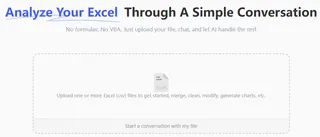
Start by uploading your existing Excel or CSV file to Excelmatic. It doesn't need to be perfectly formatted. It can be a raw data export from another system, a simple list you've typed up, or a collection of unorganized entries. For example, a simple task list with columns like Task, Owner, and Due Date.
2. Describe Your Desired Tool in Plain Language
This is where the magic happens. Instead of searching for a template, you just ask Excelmatic to build what you need.
Here are a few examples based on common business templates:
- For a Project Tracker: "Turn this list of tasks into a project tracker. Add a 'Status' column with options: 'Not Started', 'In Progress', 'Completed'. Then, create a bar chart showing the number of tasks per owner."
- For a Budget Analyzer: "I've uploaded my monthly transactions. Group my expenses by 'Category' and calculate the total spending for each. Then, create a pie chart to show the spending distribution. Also, highlight any single expense over $500."
- For a Content Calendar: "Create a content calendar from this list of blog post ideas. I need columns for 'Topic', 'Author', 'Publish Date', and 'Status'. Sort the entire table by 'Publish Date'."
- For an Invoice: "Generate a professional invoice. My company details are [Your Details]. The client is [Client Details]. The items are [Item 1, price; Item 2, price]. Calculate the subtotal, add a 15% tax, and show the final total."

3. Review, Refine, and Iterate
Excelmatic doesn't just give you a final product; it starts a conversation. It will generate the table, formula, or chart you asked for and show you the result.
From there, you can easily refine it with follow-up requests:
- "Great. Now can you filter this to only show tasks due this week?"
- "Add another column that calculates the days remaining until the due date."
- "Change the pie chart to a bar chart and sort it from highest to lowest."
This conversational approach allows you to build a complex, perfectly tailored tool step-by-step, without ever writing a formula.
4. Export Your Custom Solution
Once you're happy with the result, you can download the work as a new, clean Excel file. It will contain the AI-generated tables, charts, pivot tables, and formulas, all ready to be used and shared.
Dialogue Example: Building a Project Tracker
Here’s a realistic conversation you could have with Excelmatic:
User: I uploaded my team's raw task list with columns for 'Task Description', 'Assigned To', 'Start Date', and 'End Date'. Can you turn this into a proper project timeline tracker?
Excelmatic: Absolutely. I've organized your data into a clean table and sorted it by 'Start Date'. I also added a 'Duration (in days)' column by calculating the difference between the 'End Date' and 'Start Date'. Would you like to visualize this timeline?
User: Yes, please create a Gantt-style bar chart. Also, add a 'Status' column with a dropdown list of 'Pending', 'In Progress', and 'Done'. Finally, can you highlight all tasks assigned to 'David' in blue?
Excelmatic: Done. I have generated a Gantt chart visualizing your project schedule. The 'Status' column with dropdowns has been added, and all of David's tasks are now highlighted in blue. You can download the updated Excel file now.
Traditional Templates vs. Excelmatic: A Quick Comparison
| Feature | Static Excel Template | Excelmatic (Excel AI) |
|---|---|---|
| Starting Point | Generic, pre-defined structure | Your own raw data, no matter the format |
| Customization | Hard. Requires deep formula/Excel knowledge. | Easy. Done via simple, natural language chat. |
| Flexibility | Low. You must adapt to the template. | High. The tool adapts to your exact needs. |
| Time to Value | Hours of tweaking and manual data entry. | Minutes from data upload to actionable insight. |
| Analysis Power | Static. Cannot answer ad-hoc questions. | Dynamic. Enables conversational data analysis. |
FAQ
1. Do I need to be an Excel expert to use Excelmatic? Not at all. If you can describe what you want in a sentence, you can use Excelmatic. It's designed for business users who know their goal but don't want to get bogged down in formulas and technical steps.
2. Is my data safe when I upload it to Excelmatic? Yes. Data security and privacy are top priorities. Excelmatic uses enterprise-grade security measures to protect your data, which is never used for training models. For detailed information, always refer to the official privacy policy.
3. Can Excelmatic create complex tools like Gantt charts or financial models? Yes. By breaking down your request into logical steps, you can guide the AI to build sophisticated tools. You can ask it to create calculated columns, build pivot tables, generate charts, and combine them all into a dashboard, piece by piece.
4. What if my data is messy or disorganized? Excelmatic is great for data cleaning. You can ask it to "remove duplicate rows," "split the 'Full Name' column into 'First Name' and 'Last Name'," "find and replace all instances of 'USA' with 'United States'," or "format the 'Date' column as YYYY-MM-DD."
5. Can I export the results back into a normal Excel file? Absolutely. You can download a new Excel workbook containing all the tables, charts, and pivot tables generated by the AI. The formulas are unlocked, so you can inspect, modify, or reuse them in your other work.
Take Action: Build, Don't Search
Stop wasting your valuable time searching for and fighting with generic Excel templates. Your business challenges are unique, and your tools should be too. The era of building custom, intelligent spreadsheets with just a few words is here.
Instead of adapting your work to a flawed template, you can now create a perfect tool that adapts to your work. This not only saves countless hours but also empowers you to answer deeper questions about your data and make better, faster decisions.
Ready to build your own custom business tools without writing a single formula? Try Excelmatic today. Upload a spreadsheet you're working on right now and ask it to build the report, tracker, or dashboard you truly need.