
Key takeaways:
- Manually applying strikethrough with shortcuts (
Ctrl+5) or setting up complex conditional formatting for task lists in Excel is time-consuming and difficult to maintain. - Excel AI tools like Excelmatic replace these manual steps. You can simply describe the formatting rule in plain language, such as "If the status is 'Done', apply strikethrough to the task name."
- Using Excelmatic to automate task formatting not only saves significant time but also eliminates manual errors, making your project trackers more dynamic, accurate, and easier for your entire team to manage.
Problem Background & Pain Points
If you've ever managed a project, a team's workload, or even a personal to-do list in Excel, you know the simple satisfaction of marking a task as "complete." A common way to do this visually is by applying a strikethrough to the task description. It instantly communicates that the item is done and no longer requires attention, bringing clarity to an otherwise cluttered list.
The scene is familiar: you have a worksheet with columns for 'Task Name', 'Assigned To', 'Due Date', and 'Status'. As team members update the status of their tasks to "Done" or "Completed," you want the sheet to reflect this progress automatically.
But Excel doesn't make this as straightforward as it sounds. You're left with a few frustrating options:
- Manual Formatting: You hunt down each completed task and press
Ctrl+5. This is manageable for a few items, but for a list with dozens or hundreds of tasks updated daily, it's a recipe for tedium and mistakes. Did you miss one? Did you strike through the wrong one? - Complex Rules: You might try to be clever and use Conditional Formatting. While powerful, this feature can feel like a maze of menus, dialog boxes, and formula syntax. It's not intuitive for many users and becomes a headache to manage as your list grows or your rules change.
The core problem is that a simple, universal need—"when this task is done, cross it out"—requires disproportionate manual effort or technical knowledge in a traditional Excel environment. This friction slows you down and distracts you from the actual work you're trying to manage.
Traditional Excel Solutions: Steps & Limitations
To tackle this, experienced Excel users typically turn to two main approaches: the quick-and-dirty manual method or the more robust but complex conditional formatting.
The Manual Approach: Shortcuts and Menus
For a one-off change, the manual way is fastest.
- Select the cell(s) containing the task you want to strike through.
- Press the keyboard shortcut
Ctrl+5. - Alternatively, press
Ctrl+1to open the Format Cells dialog, navigate to the Font tab, and check the Strikethrough box.
This works, but it's not a "solution" for a dynamic list. It's a purely manual action with several limitations:
- Time-Consuming: Applying this format to dozens of tasks across a large project plan is a mind-numbing, repetitive chore.
- Error-Prone: It's easy to accidentally apply the format to the wrong cell or forget to apply it to a completed task, leading to an inaccurate view of your project's status.
- Not Dynamic: If a task's status is mistakenly changed to "Done" and then reverted, you have to remember to go back and manually remove the strikethrough. The format is not linked to the data.
The "Smarter" Way: Conditional Formatting
Conditional Formatting allows you to apply formatting automatically based on a cell's value. To apply strikethrough when a task's status is "Done," you'd follow these steps:
- Select the range of cells containing your task names (e.g.,
A2:A100). - Go to the Home tab, click Conditional Formatting, and select New Rule.
- In the dialog box, choose "Use a formula to determine which cells to format."
- In the formula bar, you'd type a formula that refers to the status column. If your status is in column C, the formula would be
=$C2="Done". - Click the Format... button, check the Strikethrough box, and click OK twice.
While this is a huge improvement over the manual method, it comes with its own set of challenges:
- Complexity: The process involves navigating multiple menus and understanding the concept of creating a rule. This is often intimidating for casual Excel users.
- Formula Anxiety: Why
=$C2and not$C$2orC2? The subtle difference between relative and absolute references is a common point of failure. A small mistake in the formula can cause the rule to not work at all, with little feedback on what went wrong. - Maintenance Overhead: When you add new tasks to your list, you must remember to update the "Applies to" range for your conditional formatting rule. If you don't, the new tasks won't be formatted correctly.
- Rigidity: What if your boss asks for a quick change? "Can you also make the overdue tasks have a red background?" This requires setting up a second complex rule. "Can you move all completed tasks to an archive sheet?" Conditional formatting can't do that at all—you're back to manual work.
The New Solution: Using Excel AI (with Excelmatic)

Instead of wrestling with menus and formulas, what if you could just tell Excel what you want? This is exactly what Excel AI Agents like Excelmatic are designed for. You stay focused on the "what" (your goal), and the AI handles the "how" (the steps in Excel).
The Overall Idea
With Excelmatic, you upload your task list, and then use a chat-like interface to describe the formatting you need in plain language. The AI analyzes your data and your request, then applies the correct formatting, formulas, or even conditional formatting rules for you.
Let's solve the same problem—automatically applying strikethrough to completed tasks—using this new approach.
Step-by-Step with Excelmatic
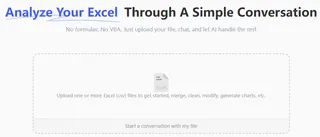
- Upload Your Data File Simply drag and drop your Excel or CSV task list into the Excelmatic web interface. The AI will read your headers and data structure.
Describe Your Goal in Natural Language Now, instead of clicking through menus, you just type your request in the chat box. Here are a few examples of prompts you could use:
- "For every row where the 'Status' column is 'Completed', apply a strikethrough format to the text in the 'Task Name' column."
- "I want to cross out any task that is marked as 'Done'."
- "Create a conditional formatting rule: if column C equals 'Done', apply strikethrough to the cell in column A on the same row."

Review and Iterate on the Result Excelmatic will process your request and show you a preview of the updated table. It might also confirm its action, for example: "I have applied a conditional formatting rule that will automatically apply strikethrough to tasks marked as 'Completed'."
The real power comes from the ability to continue the conversation. You can easily build on your initial request:
- "Great. Now, also sort the list so all 'Completed' tasks are at the bottom."
- "Can you also highlight any task in red where the 'Due Date' is in the past and the 'Status' is not 'Completed'?"
- "Filter out all the completed tasks and show them on a separate sheet named 'Archive'."
Export Your File Once you're happy with the result, you can download a new Excel file with all the formatting, rules, and changes applied. Your original file remains untouched. You can open the downloaded file and see the conditional formatting rules that the AI created for you.

A Sample Conversation in Excelmatic
Here’s how a typical interaction might look:
User: I've uploaded my project task list. When I mark a task's status as 'Complete' in column D, I want the corresponding task name in column B to be automatically struck through.
Excelmatic: Understood. I have applied a conditional formatting rule to column B. Now, whenever a cell in column D is updated to 'Complete', the task name in column B on the same row will get a strikethrough. Would you like to make any other adjustments?
User: Yes, that's perfect. Could you also sort the entire sheet to move all 'Complete' tasks to the bottom?
Excelmatic: Done. The list has been sorted to place all tasks with the 'Complete' status at the end. The conditional formatting remains active. You can now download the updated Excel file.
Traditional Method vs. Excelmatic: A Quick Comparison
| Aspect | Traditional Excel (Conditional Formatting) | Excelmatic (AI Agent) |
|---|---|---|
| Setup Time | 5-15 minutes, depending on familiarity | Less than 1 minute |
| Required Skill | Understanding of Conditional Formatting UI, formula syntax, and cell references. | Ability to describe the business goal in plain language. |
| Flexibility | Low. Each new requirement (e.g., adding color, sorting) is a separate, manual process. | High. You can ask for additional changes in the same conversation. |
| Maintenance | Manual. Ranges and rules must be updated by hand as data is added or changed. | Zero. The AI applies the logic to the entire dataset you provide. |
FAQ
Q: Do I need to know any Excel formulas to use Excelmatic for this?
A: Absolutely not. You only need to describe the outcome you want, like "cross out finished tasks." The AI translates your language instruction into the correct Excel rule.
Q: Will Excelmatic modify my original Excel file?
A: No. Excelmatic works on a copy of your data in a secure cloud environment. Your original file is never changed. You download a new file containing the results.
Q: My company uses "Finished" instead of "Done" for status. Can Excelmatic handle that?
A: Yes. Because you're using natural language, you can be specific. Just tell the AI: "When the status is 'Finished', apply strikethrough." It will adapt to your specific terminology.
Q: Can Excelmatic handle more than just strikethrough?
A: Definitely. You can ask it to apply any formatting—colors, bold, italics—based on any conditions. You can also ask it to sort, filter, create pivot tables, generate formulas, and build charts.
Q: Is it safe to upload my company's data to Excelmatic?
A: Excelmatic is built with data security as a priority. All data is encrypted and processed in a secure environment. For specific details on data handling and privacy, it's always best to consult the official privacy policy on the website.
Q: Can I see the conditional formatting rule that Excelmatic creates?
A: Yes. When you download the resulting Excel file, the conditional formatting rules applied by the AI are saved in the file. You can inspect them by going to Home > Conditional Formatting > Manage Rules in Excel.
Take Action: Revolutionize Your Excel Workflow Today
Think about the time you spend each week manually formatting reports and tracking lists. Every minute spent clicking through menus or debugging a formula is a minute not spent on strategic work. Continuing with the old way means accepting this inefficiency as a cost of doing business.
With an Excel AI agent like Excelmatic, you can reclaim that time. Instead of being an Excel operator, you become a manager who simply delegates the tedious tasks to a capable AI assistant. Your task lists will be more accurate, always up-to-date, and easier for everyone to read.
Ready to give it a try? Try Excelmatic for free today. Upload that to-do list you've been working on and use one of the prompts from this article. See for yourself how a simple conversation can transform your Excel workflow.