Key takeaways:
- Marketing platforms over-attribute conversions, causing Shopify brands to scale the wrong ads.
- AI marketing attribution dashboards use multi-touch analysis to reveal how channels actually work together.
- Assisted conversions and conversion lag time are critical for understanding real ad performance.
- Excelmatic turns raw Shopify and ad data into an automated attribution dashboard without manual reporting.
If you run a Shopify store, you've probably lived through this "ghost story":
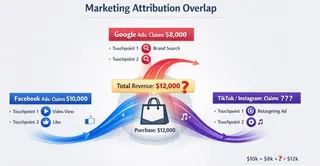
Facebook Ads Manager tells you that your latest campaign brought in $10,000. Google Ads claims credit for another $8,000. You're excited — until you check your Shopify dashboard and realize your total revenue for the week was only $12,000.
Where did the other $6,000 go? It didn't vanish into thin air. You're just witnessing the Attribution Overlap. Every platform is grading its own homework, and they all want to be the valedictorian.
For most e-commerce brands, this isn't just a reporting headache — it's a massive drain on your profit margins. When you don't know which ads are actually moving the needle, you end up scaling the wrong campaigns and killing the ones that are quietly doing the heavy lifting. This is why the AI Marketing Attribution Dashboard has moved from a "nice-to-have" luxury to a total survival tool for ad spend optimization.
Why Your Shopify Store Needs an AI-Powered Marketing Attribution Dashboard
Let's be clear: an effective dashboard is not just a collection of pretty charts and neon colors.
In the old days (which was basically two years ago), we lived and died by "Last-Click" attribution. Whoever got the final click before the purchase got 100% of the credit. But let's be real — humans don't work like that. A customer might see your TikTok ad while drinking coffee, Google your brand name during lunch, and finally buy from a retargeting ad on Instagram that evening.
An AI Marketing Attribution Dashboard acts as the "referee" in this chaos. It uses machine learning for multi-touch attribution (MTA) to look at every single touchpoint and say, "Okay, TikTok started the fire, Google fanned the flames, and Instagram just put the cherry on top." Its strategic value is simple: it closes the Decision Latency gap — the time you waste wondering where to put your next dollar while your competitors are outspending you.
The Anatomy of an Analytical Dashboard for Cross-Channel Ad Tracking
A professional-grade analytical dashboard for Shopify shouldn't just "vomit" data at you. If you have to spend twenty minutes squinting at a screen to find an insight, the dashboard has failed. It needs to tell a story through three specific lenses:
1. The Multi-Touch Journey Map
It should visualize the messy, non-linear path from "Stranger" to "Customer." If most of your buyers need 5 touches over 10 days, your dashboard should show that clearly. That way, you don't panic and kill a top-of-funnel ad just because it didn't convert "instantly."

2. Cross-Device Identification
AI helps bridge the gap between the person browsing on their iPhone during a commute and finally hitting the 'Buy' button on their MacBook at the office. This is crucial for accurate cross-channel ad tracking.

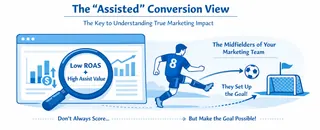
3. The "Assisted" Conversion View
This is probably the most underrated part of marketing. It highlights ads that have a low ROAS but a high "Assist Value." These are the midfielders of your marketing team — they don't always score the goal, but the goal doesn't happen without them.
Essential E-commerce Metrics for Strategic Ad Spending
To move beyond "guessing" and gut feelings, you need a data-driven attribution model. We've broken down four indicators that actually matter for your bottom line, and how AI changes the game:
| Metric | The "Real Talk" Definition | Why AI Makes it Better |
|---|---|---|
| MER (Marketing Efficiency Ratio) | Total Revenue divided by Total Ad Spend. The "North Star" of e-commerce. | AI identifies the specific "sweet spot" MER for your niche and season. |
| Assisted Conversions | Sales where a channel was a "touchpoint" but not the final click. | Stops you from accidentally killing the ads that "seed" your entire market. |
| Conversion Lag Time | How many days or hours pass between the first click and the purchase. | Helps you set realistic retargeting windows so you don't overspend on ads. |
| First-Click vs. Last-Click Gap | The difference in value attributed to the start vs. the end of the funnel. | Reveals which channels are your true Discovery engines vs. your Closers. |
The Shopify Reality Check: From Data Noise to Strategic Reasoning
Here is a scenario we see all the time: A brand spends $2,000 on "Top of Funnel" YouTube ads. The direct ROAS looks like absolute garbage — maybe 0.5x. Most managers, driven by fear and bad data, would kill that ad immediately.
But when you look at a proper Analytical AI Dashboard, you see the truth: 60% of your high-value customers saw that YouTube ad first. By killing that "failing" ad, you'd actually be cutting off the oxygen to your entire sales funnel.
That's the difference between looking at a static, frozen-in-time spreadsheet and having a strategic reasoning system. One just gives you a headache; the other gives you a roadmap.
Solving the "Manual Mess" with Automated Marketing Reporting
The reason most Shopify owners don't do this is that it's a nightmare to set up. You have to export CSVs from Meta, Google, and Shopify, then spend four hours in Excel trying to make the dates and UTM parameters match. By the time the report is finally done, the data is already old news.
Excelmatic was built to solve exactly this "spreadsheet hell." We realized that you don't need a $50,000 enterprise BI tool to get clear answers. You just need a way to turn your raw data into an analytical structure — automatically.

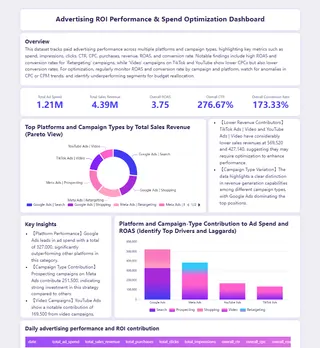
Excelmatic plugs into your data and builds these logical attribution paths for you. It cleans up the "noise," deduplicates the credit, and gives you a clear visual hierarchy of what's working. You get the power of predictive marketing analytics with the familiar flexibility of a spreadsheet... but without the broken formulas and the manual labor.
Stop Guessing, Start Scaling Your Ad Spend
At the end of the day, your ad budget is either a calculated investment or a blind gamble. Without a clear attribution dashboard, let's be honest: you're gambling.
When you can see the full journey — from that first curious click to the final "Order Confirmed" page — you stop making decisions based on "gut feelings" or what you think is happening. You start making them based on Root-Cause Exploration.
Ready to see which ads are actually paying your bills? Explore how Excelmatic can build your Shopify Attribution Dashboard today.
Frequently Asked Questions (FAQ)
Q: What is an AI marketing attribution dashboard?
A: An AI marketing attribution dashboard uses machine learning to analyze multi-touch customer journeys and determine how different ads and channels contribute to conversions.
Q: Why is last-click attribution misleading for Shopify stores?
A: Last-click attribution ignores earlier touchpoints that influence purchase decisions, leading brands to overvalue retargeting ads and undervalue discovery channels.
Q: What metrics matter most in AI marketing attribution?
A: Key metrics include MER (Marketing Efficiency Ratio), assisted conversions, conversion lag time, and the gap between first-click and last-click attribution.
Q: How does AI improve cross-channel ad tracking?
A: AI connects interactions across devices and platforms, helping Shopify brands understand how ads work together instead of competing for credit.
Q: How does Excelmatic help with marketing attribution dashboards?
A: Excelmatic automates data cleanup, deduplicates attribution paths, and builds analytical dashboards from Shopify and ad platform data without manual spreadsheets.